



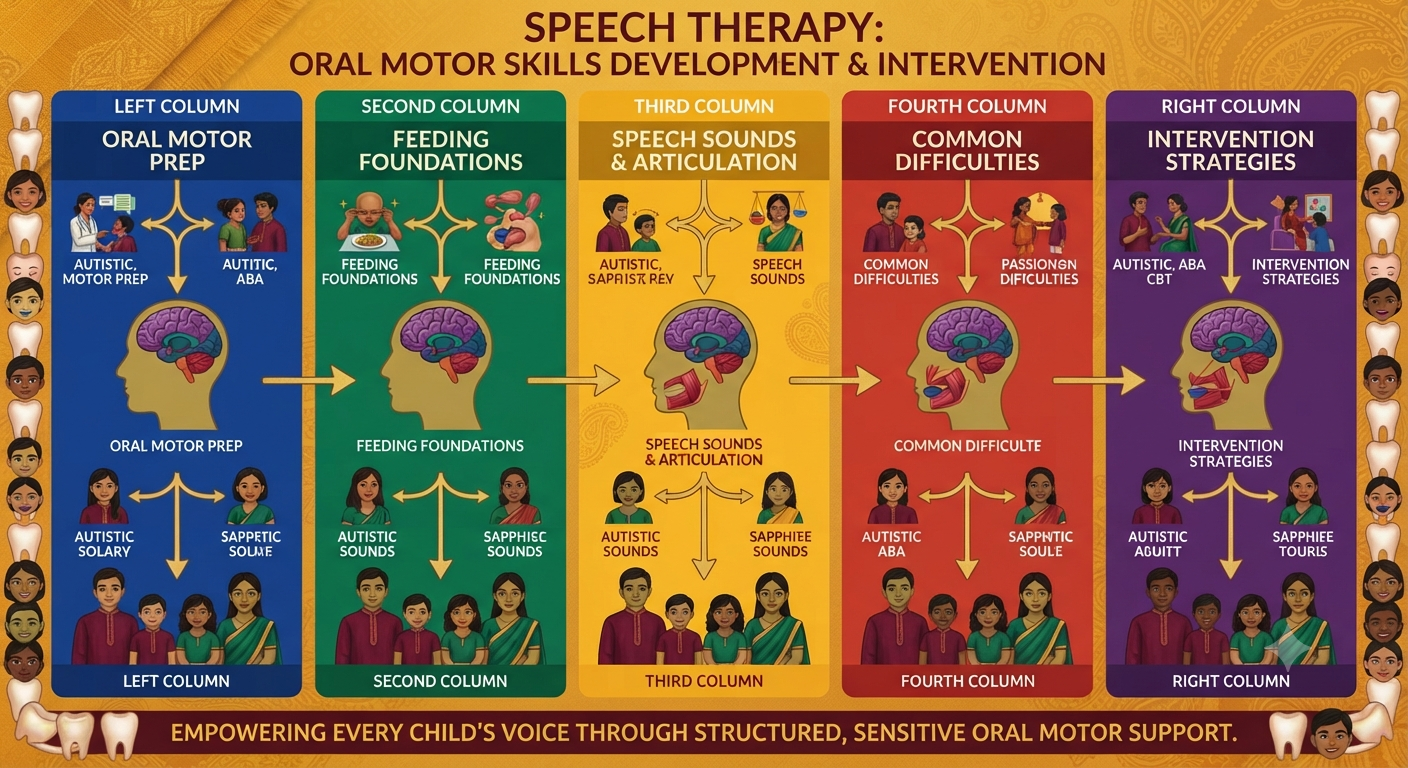
Oral-Motor Skills in Speech Therapy
1. What are Oral-Motor Skills?
Oral-motor skills are the abilities of the lips, tongue, jaw, cheeks, and palate to move with strength, coordination, and control for:
👉 Simply:
“How well the mouth muscles work to make clear speech.”
2. Why Oral-Motor Skills are Important
Speech sounds need precise mouth movements:
-
Lips → /p, b, m, w/
-
Tongue tip → /t, d, n, l/
-
Tongue back → /k, g/
-
Teeth + tongue → /s, z, th/
If oral muscles are weak or poorly coordinated, speech becomes:
-
Unclear
-
Slurred
-
Distorted
3. Children Who Commonly Need Oral-Motor Therapy
-
Children with unclear articulation
-
Speech sound disorders
-
Autism (motor planning + coordination issues)
-
Cerebral palsy
-
Down syndrome
-
Feeding / drooling issues
-
Apraxia of speech (with caution & specific approach)
⚠️ Oral-motor therapy is not for every child—it is used only when muscle weakness or coordination problems are present.
4. Assessment of Oral-Motor Skills
An SLP checks:
-
Lip closure & rounding
-
Tongue movement (up, down, side)
-
Jaw stability
-
Cheek strength
-
Breath control
-
Coordination during speech
5. Oral-Motor Therapy Techniques (with Examples)
A. Lip Strength & Control
Activities:
-
Blowing bubbles
-
Blowing candles
-
Straw drinking (thick liquids first)
-
Lip rounding (“oo”) and smiling (“ee”)
Helps with:
/p, b, m, w/ sounds
B. Tongue Strength & Movement
Exercises:
-
Tongue up to roof of mouth
-
Side-to-side tongue movement
-
Licking honey/jam from lips
-
Tongue push against spoon
Helps with:
/t, d, n, l, s, r/ sounds
C. Jaw Stability
Activities:
-
Chewing chewy foods (under supervision)
-
Bite-and-hold exercises
-
Jaw opening/closing control
Helps with:
Clear speech, feeding, reduced drooling
D. Cheek Strength
Exercises:
-
Puff cheeks and hold air
-
Sucking through straw
-
Blowing whistles
E. Breath Control
Activities:
-
Blowing cotton balls
-
Bubble blowing
-
Long sound holding (“ssss”, “aaaa”)
Helps with:
Speech clarity and fluency
6. How Oral-Motor Therapy is Used Correctly
✔️ Combined with speech sound practice
✔️ Short, fun sessions (5–10 minutes)
✔️ Done under SLP guidance
✔️ Gradually transferred to real speech
❌ Not random mouth exercises
❌ Not forced or painful
❌ Not done without purpose
7. Parent Guidelines (Very Important)
-
Never force exercises
-
Always make it play-based
-
Practice in front of a mirror
-
Stop if child is tired or frustrated
-
Follow therapist’s exact instructions
8. When Improvement is Seen
-
Muscle control → 4–6 weeks
-
Clearer speech → 2–3 months (with regular practice)
Consistency is key.
9. One-Line Summary
Oral-motor skills are the foundation of clear speech, and speech therapy strengthens and coordinates mouth muscles to support accurate sound production