



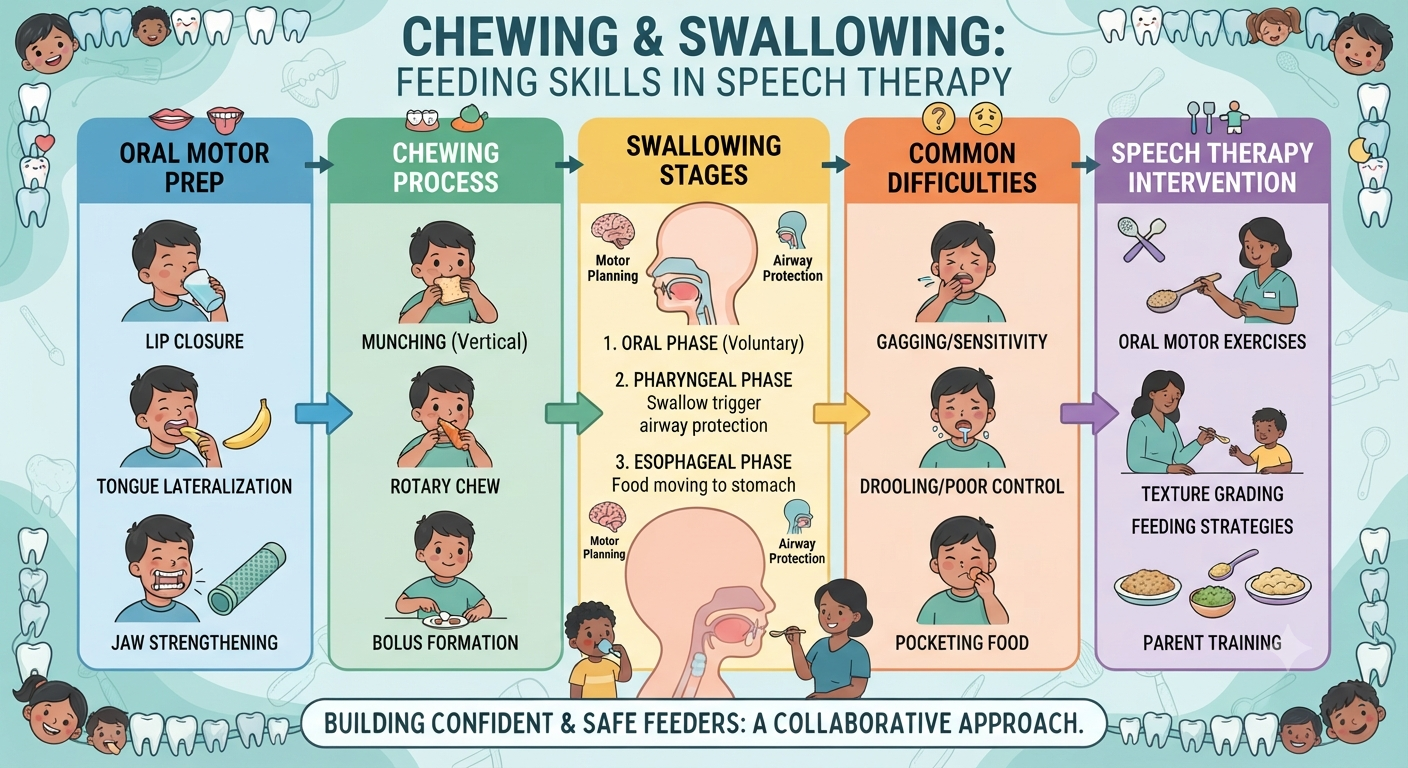
Speech-Language Pathologists (SLPs) do not work only on speech.
They also assess and treat chewing and swallowing difficulties, because these skills use the same mouth muscles needed for speech.
1. What are Chewing and Swallowing?
Chewing (Mastication)
Chewing is the ability to:
-
Bite food
-
Move it side to side
-
Grind it using teeth
-
Mix it with saliva to form a bolus (food ball)
Swallowing (Deglutition)
Swallowing is the process of:
-
Moving food from mouth → throat → food pipe → stomach
-
Safely, without choking or coughing
👉 Simply:
Chewing prepares food. Swallowing moves it safely to the stomach.
2. Why Chewing & Swallowing are Important
-
Nutrition & growth
-
Safety (prevents choking/aspiration)
-
Oral-motor strength for clear speech
-
Independence in eating
-
Proper jaw and facial development
⚠️ Poor chewing can affect speech clarity, drooling, and articulation.
3. Normal Development of Chewing & Swallowing (Approx.)
| Age | Skill |
|---|---|
| 6 months | Purees, suck–swallow |
| 8–9 months | Mashed foods, munching |
| 10–12 months | Soft solids, emerging chewing |
| 18 months | Rotary (side-to-side) chewing |
| 2–3 years | Chews most textures safely |
4. Signs of Chewing & Swallowing Problems
Chewing difficulties
-
Swallows food without chewing
-
Uses only front teeth
-
Food stays in mouth for long time
-
Cannot move food side to side
-
Gags on textured food
-
Prefers only soft foods
Swallowing difficulties (Red Flags 🚩)
-
Coughing/choking while eating or drinking
-
Wet or gurgly voice after swallowing
-
Frequent chest infections
-
Food coming out of nose or mouth
-
Excessive drooling
-
Poor weight gain
🚨 These need immediate professional evaluation.
5. Causes of Chewing & Swallowing Difficulties
-
Weak oral muscles
-
Poor tongue movement or coordination
-
Sensory issues (texture aversion – common in autism)
-
Low jaw stability
-
Neurological conditions (CP, prematurity)
-
Structural issues (tongue tie, cleft palate)
-
Prolonged bottle feeding
6. How Speech Therapy Helps (Step-by-Step)
A. Assessment
SLP evaluates:
-
Lip closure
-
Tongue movement
-
Jaw control
-
Chewing pattern
-
Swallow safety
-
Food textures tolerated
B. Oral-Motor Strengthening
(Only if weakness is present)
Examples:
-
Chewy foods (supervised)
-
Straw drinking
-
Blowing activities
-
Tongue lateralization exercises
C. Chewing Training
-
Start with soft, dissolvable foods
-
Place food on side gums, not middle
-
Encourage side-to-side tongue movement
-
Gradually increase food texture
Food hierarchy:
Puree → mashed → soft solids → mixed textures → regular solids
D. Swallowing Therapy
-
Correct posture while eating
-
Pacing (small bites, slow eating)
-
Thickened liquids (if advised)
-
Safe swallowing strategies
⚠️ Swallow therapy is highly individualized.
E. Sensory Feeding Therapy (Very important in Autism)
-
Desensitization to textures
-
Touch → smell → lick → bite → chew → swallow
-
No force feeding
7. Parent Guidelines (Very Important)
✅ Sit child upright (90° posture)
✅ Offer age-appropriate textures
✅ Encourage chewing on both sides
✅ Be patient and calm
❌ Do not force-feed
❌ Do not distract excessively (mobile, TV)
❌ Do not rush meals
8. When to See a Doctor + SLP Immediately 🚨
-
Frequent choking
-
Recurrent pneumonia
-
Blue lips or breathing difficulty during feeding
-
Poor weight gain
-
Suspected aspiration
9. Connection Between Feeding & Speech
| Feeding Skill | Supports Speech |
|---|---|
| Lip closure | /p, b, m/ |
| Tongue movement | /t, d, l, s/ |
| Jaw stability | Clear articulation |
| Breath control | Voice & fluency |
10. One-Line Summary
Chewing and swallowing are complex oral-motor skills, and speech therapy helps children eat safely, efficiently, and develop the mouth strength needed for clear speech.