



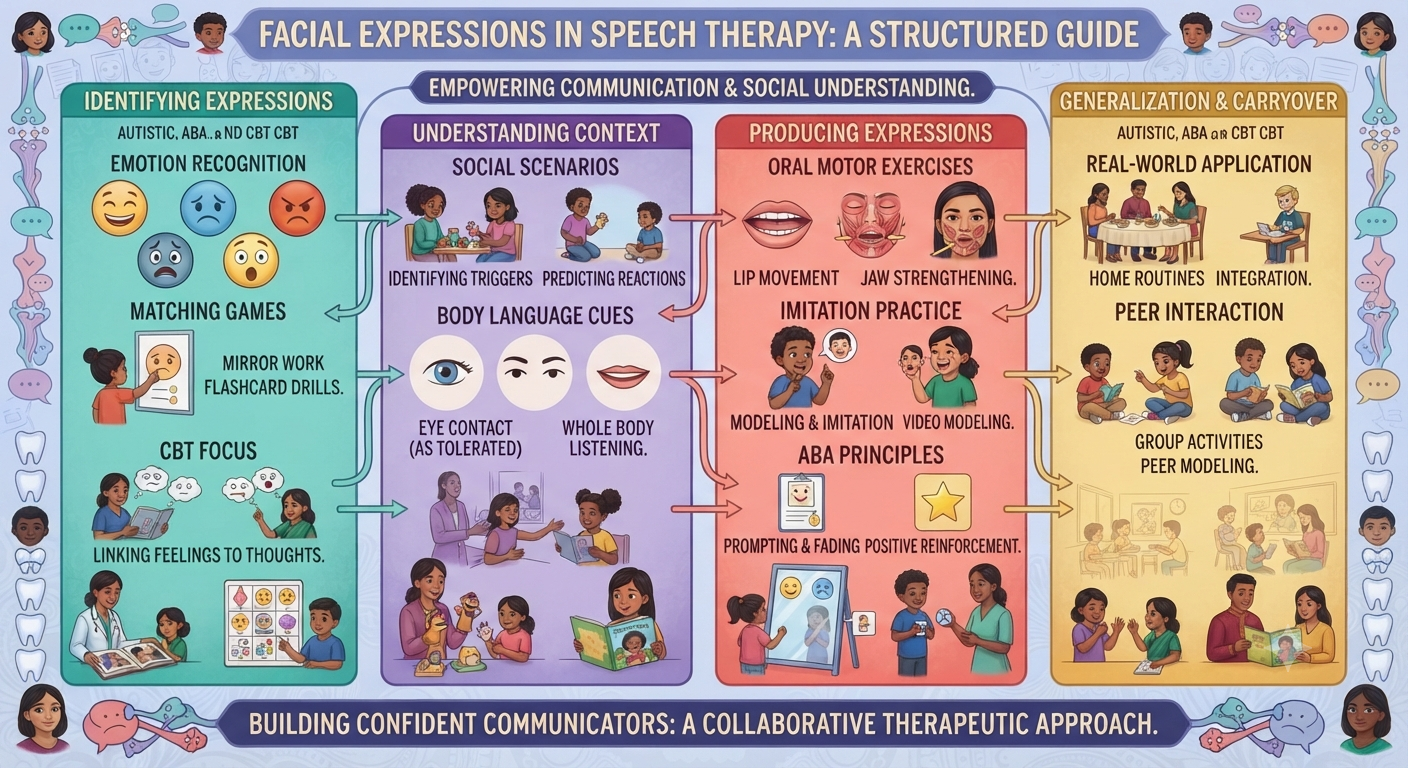
1. What are Facial Expressions?
Facial expressions are movements of the face muscles (eyes, eyebrows, lips, cheeks, jaw) used to show:
-
Emotions (happy, sad, angry, surprised)
-
Intent (interest, confusion, excitement)
-
Communication signals (agreement, refusal, attention)
👉 Simply:
“Facial expressions help others understand what we feel and mean—even without words.”
2. Why Facial Expressions Matter in Speech Therapy
Facial expressions are a core part of communication, not just emotions.
They help with:
-
Social communication (pragmatics)
-
Speech clarity (lip and jaw movement)
-
Emotional understanding
-
Non-verbal communication
⚠️ Children may speak words correctly but still struggle to express emotions or intent through their face.
3. Children Who Commonly Need Facial Expression Therapy
-
Autism Spectrum Disorder (reduced or inappropriate expressions)
-
Speech sound disorders (poor lip/jaw movement)
-
Motor planning difficulties / Apraxia
-
Down syndrome (low muscle tone)
-
Facial muscle weakness
-
Children with flat affect or limited emotional expression
4. Signs of Difficulty with Facial Expressions
-
Limited or flat facial expressions
-
Expressions don’t match emotions or situation
-
Poor eye contact
-
Difficulty copying facial movements
-
Trouble understanding others’ expressions
-
Over-exaggerated or inappropriate expressions
5. How Speech Therapy Works on Facial Expressions
A. Facial Awareness Training
Child learns:
-
Where facial muscles are
-
How different expressions feel
Activities:
-
Mirror work
-
Naming facial parts
-
“Show me your happy face”
B. Facial Muscle Activation
Strengthening and coordination of face muscles.
Exercises:
-
Smile wide → hold → relax
-
Pucker lips (“kiss”)
-
Puff cheeks
-
Raise eyebrows
-
Open mouth wide → close slowly
(Always done playfully, never forced)
C. Imitation & Modeling
-
Therapist models expressions
-
Child imitates
Examples:
-
Happy 😄
-
Sad 😢
-
Angry 😠
-
Surprised 😲
D. Emotion Recognition & Matching
-
Identify emotions in pictures, toys, videos
-
Match facial expression to emotion
Example:
-
“The boy lost his toy. How does he feel?”
E. Role Play & Social Stories
-
Practice expressions in real-life situations
Examples:
-
Greeting someone (smile + eye contact)
-
Saying sorry (sad face)
-
Winning a game (happy face)
F. Speech + Facial Expression Integration
-
Pair expressions with speech sounds or words
Examples:
-
Smile while saying “ee”
-
Pucker lips while saying “oo”
-
Express feelings verbally: “I am happy”
6. Parent Role at Home
-
Model clear facial expressions
-
Label emotions: “You look happy!”
-
Use mirror games daily (2–5 minutes)
-
Read storybooks and discuss characters’ feelings
-
Praise correct expression attempts
7. Progress Timeline (Approx.)
-
Awareness & imitation → 2–4 weeks
-
Better emotional expression → 2–3 months
-
Social use of expressions → ongoing practice
Consistency matters more than intensity.
8. One-Line Summary
Facial expressions are a vital part of communication, and speech therapy improves awareness, muscle control, emotional understanding, and social use of facial cues.
[…] Facial Expressions […]