


What are brain gym exercises for children?
Brain gym exercises for children are short, playful movements that practise coordination, balance, body awareness, motor planning, breathing and attention. They can be used as supervised movement breaks, but they should be adapted to each child and do not replace individualized medical or therapy advice.
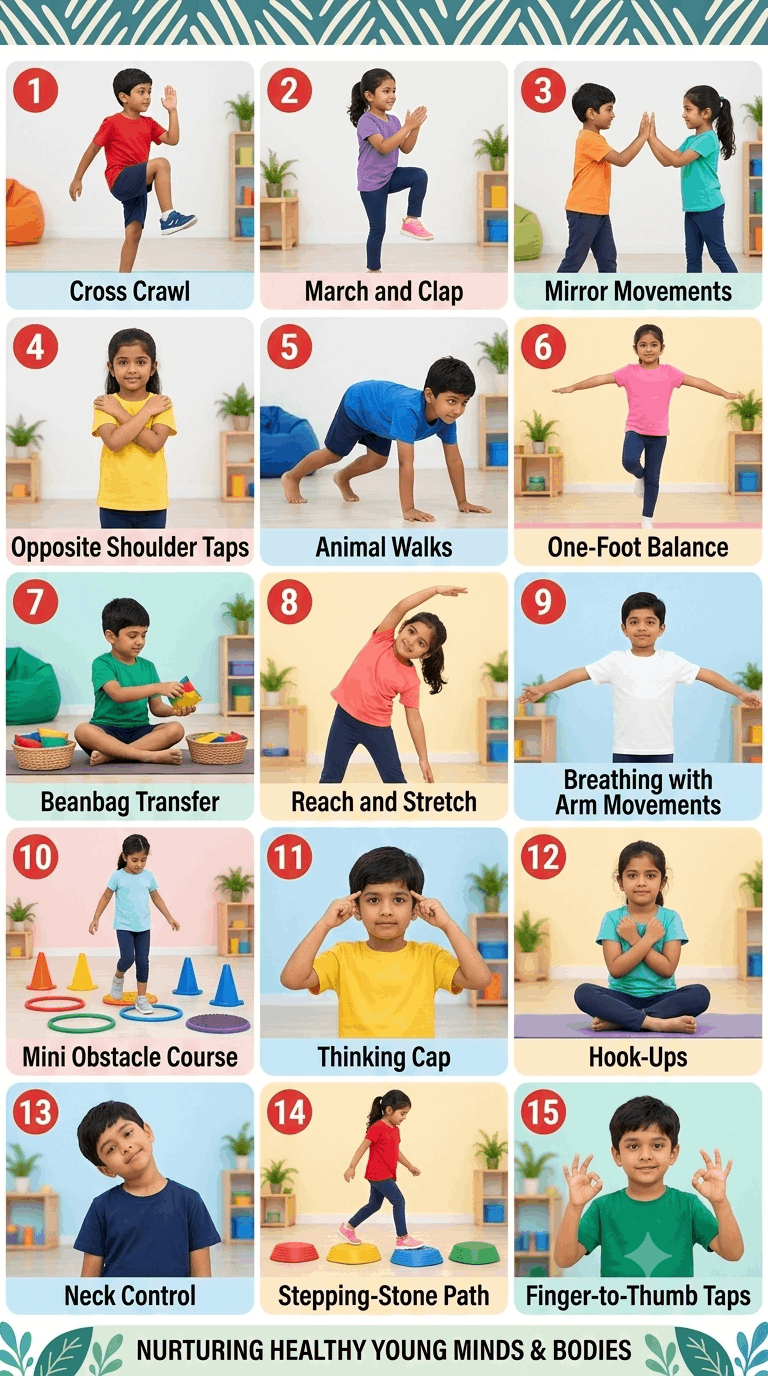
Brain gym exercises for children can make movement practice engaging by combining simple body actions with rhythm, imitation, balance, breathing or a short sequence. The sample image shows 15 activities; this page explains what each activity is intended to practise, how to introduce it, and what parents or teachers should observe.
Important evidence and safety note
These activities may support movement practice, attention breaks and self-regulation, but a movement activity should not be presented as a guaranteed way to “integrate the brain” or treat a developmental condition. Use playful, observable goals—such as stepping, balancing, following a sequence or calming breathing—and consult an occupational therapist, physiotherapist or pediatrician when concerns are significant.


Sample reference image: 15 movement activities. Use it as a visual prompt, not as a replacement for supervision or individualized assessment.
Table of Contents
Overview of the 15 Brain Gym Exercises for Children
| # | Exercise | Main skills practised | Suggested starting time |
|---|---|---|---|
| 1 | Cross Crawl | Cross-body coordination, balance and sequencing | 30–60 seconds |
| 2 | March and Clap | Rhythm, bilateral coordination and attention | 1–2 minutes |
| 3 | Mirror Movements | Imitation, visual attention and social coordination | 1–3 minutes |
| 4 | Opposite Shoulder Taps | Crossing midline, shoulder stability and body awareness | 5–10 taps per side |
| 5 | Animal Walks | Core strength, upper-body weight bearing and motor planning | 2–5 minutes |
| 6 | One-Foot Balance | Static balance, postural control and confidence | 5–10 seconds per side |
| 7 | Beanbag Transfer | Reaching, coordination, trunk rotation and sequencing | 2–5 minutes |
| 8 | Reach and Stretch | Flexibility, body awareness and controlled movement | 3–5 repetitions per side |
| 9 | Breathing with Arm Movements | Slow breathing, pacing and self-regulation | 3–5 breaths |
| 10 | Mini Obstacle Course | Motor planning, balance, agility and sequencing | 3–8 minutes |
| 11 | Thinking Cap | Pause, listening and body-awareness routine | 20–30 seconds |
| 12 | Hook-Ups | Quiet sitting, breathing and relaxation routine | 20–60 seconds |
| 13 | Neck Control | Gentle head movement, orientation and posture | 3–5 slow turns |
| 14 | Stepping-Stone Path | Dynamic balance, foot placement and sequencing | 2–5 passes |
| 15 | Finger-to-Thumb Taps | Fine motor timing, motor sequencing and hand awareness | 1–2 rounds per hand |
Detailed Brain Gym Exercises for Children
1. Cross Crawl
What it is: The child lifts one knee and brings the opposite hand toward it, then alternates sides.
How to do it:
- Stand with feet hip-width apart and arms relaxed.
- Lift the right knee while bringing the left hand toward the knee.
- Return to the starting position and switch sides.
- Begin slowly, then add a steady rhythm if the child is comfortable.
Benefits: Practises cross-body coordination, balance, sequencing, trunk control and motor planning. These are useful for everyday movements that require both sides of the body to work together.
Make it easier: Touch the knee with the same-side hand, hold a wall, or perform the movement seated. Stop if: the child becomes dizzy, unstable or frustrated.
2. March and Clap
What it is: The child marches in place while clapping to a steady beat.
How to do it:
- March slowly with small, controlled knee lifts.
- Clap once on every second step or at a simple count.
- Pause, then restart with a new rhythm.
Benefits: Supports rhythm, bilateral coordination, timing, auditory attention and following a pattern. It can be a short classroom movement break.
Progression: Add counting, a song, direction changes or an “eyes looking forward” cue. Keep the pattern simple for children who are easily overwhelmed.
3. Mirror Movements
What it is: One person leads slow movements while the child copies as though looking in a mirror.
How to do it:
- Face the child and begin with one simple movement, such as raising both hands.
- Move slowly and give the child time to copy.
- Take turns being the leader.
Benefits: Practises visual attention, imitation, motor planning, body awareness and shared interaction. It also encourages children to watch movement carefully instead of rushing.
Adaptation: Use seated movements or a visual model. Avoid fast, unpredictable motions until the child is ready.
4. Opposite Shoulder Taps
What it is: The child crosses one arm to tap the opposite shoulder, then changes sides.
How to do it:
- Stand or sit upright.
- Bring the right hand across to tap the left shoulder.
- Return the arm and tap the right shoulder with the left hand.
- Repeat slowly while breathing normally.
Benefits: Practises crossing the midline, shoulder movement, body awareness and bilateral coordination. It can prepare the body for table work without requiring equipment.
Make it easier: Tap the upper arm rather than the shoulder, or reduce the range of movement.
5. Animal Walks
What it is: The child moves like an animal—for example, bear walking, crab walking or frog jumping.
How to do it:
- Choose one animal movement and demonstrate it.
- Use a short, clear path on a non-slip surface.
- Let the child move for a few steps, rest, and try another animal if appropriate.
Benefits: Builds whole-body strength, core stability, upper-body weight bearing, coordination, body awareness and motor planning. Animal walks can also be placed between stations in an obstacle course.
Safety: Avoid slippery floors. Do not force wrist loading or frog jumps in a child with pain, weakness or joint concerns; seek professional advice first.
6. One-Foot Balance
What it is: The child stands on one foot while keeping the trunk as steady as possible.
How to do it:
- Stand near a wall or stable chair.
- Lift one foot slightly and hold for a comfortable number of seconds.
- Place the foot down, rest, and repeat on the other side.
Benefits: Practises static balance, ankle and hip control, postural stability and confidence. Balance supports everyday activities such as stairs, dressing and playground play.
Progression: Reduce hand support, use a taped target, or add a simple reach. Do not make the child close their eyes unless a therapist specifically recommends it.
7. Beanbag Transfer
What it is: The child transfers a beanbag from one side of the body to a container or target on the other side.
How to do it:
- Place a light beanbag within easy reach.
- Ask the child to pick it up, turn or reach, and place it in a bucket.
- Change the target position gradually, but keep the movement controlled.
Benefits: Supports reaching, hand-eye coordination, trunk rotation, crossing the midline, sequencing and sustained attention.
Safety: Use a soft, age-appropriate beanbag and supervise closely with children who mouth objects.
8. Reach and Stretch
What it is: The child reaches overhead or to the side with slow, comfortable stretches.
How to do it:
- Stand or sit tall with feet stable.
- Reach one arm overhead or toward a target.
- Return to the centre and change sides.
- Keep breathing and avoid bouncing or forcing the range.
Benefits: Practises flexibility, trunk movement, shoulder range, posture and body awareness. It can be useful before seated work.
Safety: Stretch should feel gentle, never painful. Stop with pain, numbness, dizziness or unusual weakness.
9. Breathing with Arm Movements
What it is: The child pairs a slow breath with a simple arm movement.
How to do it:
- Sit or stand comfortably.
- Slowly raise the arms while breathing in, if comfortable.
- Lower the arms while breathing out.
- Repeat for three to five relaxed breaths without forcing a deep inhale.
Benefits: Practises pacing, body awareness and calm breathing. It may help a child pause before a transition or return to a task.
Adaptation: Keep arms in the lap if raising them is uncomfortable. Never insist on breath holding or exaggerated breaths.
10. Mini Obstacle Course
What it is: A short sequence of safe stations such as stepping around cones, walking through hoops or stepping over a low cushion.
How to do it:
- Start with two or three stations and demonstrate the order.
- Use large, stable and soft materials with clear spaces between them.
- Let the child complete the sequence at their own pace.
- Add one station only when the child is successful and comfortable.
Benefits: Combines balance, agility, motor planning, sequencing, visual-spatial awareness and problem-solving. Obstacle courses also give children a sense of achievement.
Safety: Avoid high obstacles, sharp edges and slippery surfaces. Adult supervision is essential.
11. Thinking Cap
What it is: In the sample image, the child gently touches or cups the ears while pausing and attending.
How to do it safely:
- Invite the child to sit comfortably and place hands gently around the outer ears only if they like the touch.
- Take a quiet pause for about 20–30 seconds.
- Remove hands if the child feels uncomfortable.
Benefits: The practical goal is a quiet pause, listening and body awareness—not a guaranteed neurological “reset.” It can be used as a brief attention routine when the child enjoys it.
Safety: Do not press, pull or block the ear canal. Skip this activity for ear pain, infection, hearing devices, strong touch sensitivity or any discomfort.
12. Hook-Ups
What it is: A seated hand-and-foot position sometimes used as a quiet breathing or relaxation routine.
How to do it:
- Offer the child a comfortable seated position instead of requiring a complex pose.
- If they choose, cross ankles and rest hands comfortably, then breathe slowly.
- Keep the hold brief and release if the child dislikes it.
Benefits: The observable goals are stillness, slow breathing, body awareness and a short pause. Evidence for branded “brain integration” claims is limited, so present it as an optional relaxation routine.
Safety: Do not force twisting or joint positions. Use a neutral seated posture for children with pain, hypermobility or balance difficulty.
13. Neck Control
What it is: Slow, gentle head turns or orientation movements.
How to do it:
- Sit or stand with shoulders relaxed.
- Turn the head slowly to look toward one side.
- Return to centre and repeat to the other side.
- Keep the movement small and comfortable.
Benefits: Practises orientation, visual tracking, posture and controlled head movement.
Safety: Do not roll the neck forcefully or stretch into pain. Stop for headache, neck pain, dizziness, nausea, numbness or unusual visual symptoms.
14. Stepping-Stone Path
What it is: The child steps from one stable marker to another, as shown with coloured stepping stones.
How to do it:
- Place non-slip markers close together on a clear floor.
- Ask the child to step from one marker to the next.
- Use hand support or widen the spacing only according to ability.
Benefits: Develops dynamic balance, foot placement, weight shifting, visual-spatial awareness and sequencing.
Safety: Test every marker first. Do not use unstable stools or slippery objects as stepping stones.
15. Finger-to-Thumb Taps
What it is: The child touches the thumb to each fingertip in sequence.
How to do it:
- Rest the forearm comfortably.
- Touch the thumb to the index, middle, ring and little finger.
- Repeat in reverse order or with the other hand.
Benefits: Practises fine motor timing, finger isolation, motor sequencing and hand awareness. These skills support tasks such as manipulating fasteners, utensils and writing tools.
Progression: Add a rhythm, count aloud, or ask the child to copy a pattern. Focus on accuracy before speed.
How to Plan a Safe Movement Break
- Choose one or two activities: More is not always better. Match the activity to the child’s energy and goal.
- Prepare the space: Remove obstacles, use non-slip flooring and keep an adult nearby.
- Demonstrate first: Use short instructions and a visual model.
- Start briefly: Begin with 30 seconds to five minutes depending on the activity.
- Observe the response: Look for comfortable engagement, smoother movement and improved readiness—not forced compliance.
- Finish positively: Give the child a predictable end cue and transition to the next task.
What benefits may children experience?
With enjoyable, repeated practice, children may improve balance, bilateral coordination, body awareness, motor planning, postural control, rhythm, fine motor timing, confidence and readiness to participate. Benefits vary by child; track functional changes rather than promising a specific outcome.
Easy Adaptations and Progressions
| If the activity is too hard | If the child is ready for more challenge |
|---|---|
| Use seated movements, reduce the range, slow the pace, shorten the sequence, provide hand support, or use larger stable targets. | Reduce support gradually, add a simple rhythm, increase repetitions slightly, change direction, or add one step to the sequence. |
| Use a demonstration, picture cue or hand-over-hand support only when needed and with consent. | Ask the child to lead, remember a two-step pattern, or complete the activity in a different safe setting. |
When to Seek Professional Guidance
Speak with a pediatrician, occupational therapist or physiotherapist if a child has frequent falls, persistent pain, marked asymmetry, regression, unusual weakness, dizziness, severe fatigue, difficulty participating in age-appropriate movement, or distress that does not improve with simple adaptations. These activities should not be used to diagnose or treat a medical condition.
Stop the activity and seek advice
Stop for pain, dizziness, fainting, breathing difficulty, sudden weakness, new loss of skills, unusual movements, nausea, severe headache, or significant distress. Do not continue because an exercise is shown in a poster or because someone expects the child to finish it.
Frequently Asked Questions
What are brain gym exercises for children?
They are short, playful movements that practise coordination, balance, body awareness, motor planning, breathing and attention. They can be useful as supervised movement breaks, but they are not a replacement for individualized therapy.
How often should children do these exercises?
Begin with a few minutes and choose activities the child tolerates and enjoys. Frequency and duration should be adjusted for age, ability, fatigue, safety and professional recommendations.
Are all 15 exercises suitable for every child?
No. Children respond differently. Simplify an activity, provide support, or stop if the child experiences pain, dizziness, distress or unusual fatigue.
Can teachers use these exercises in class?
Yes. Teachers can use simple activities such as marching, cross-crawl, breathing, stretching and short obstacle paths as supervised movement breaks, while adapting them to the classroom and the child’s educational plan.