



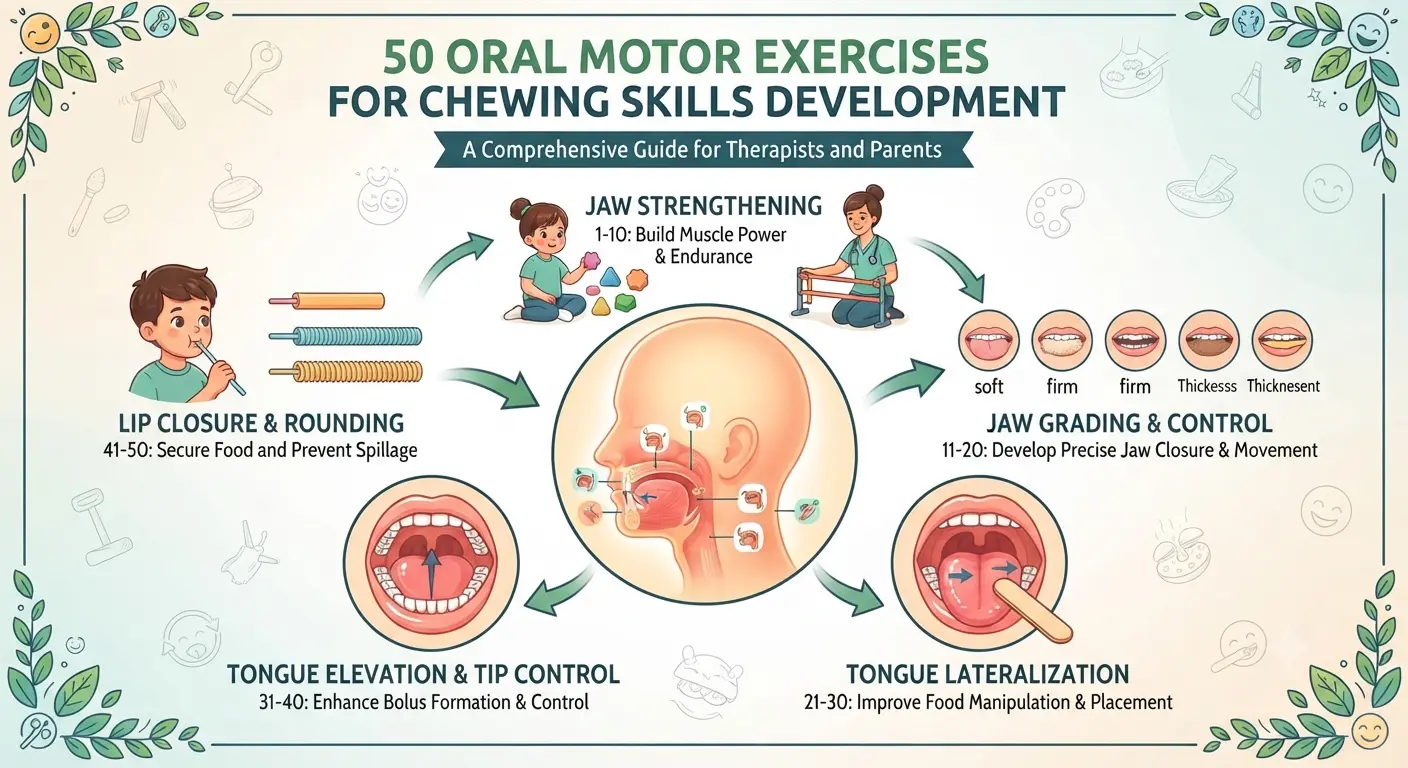
Implementing a comprehensive routine of 50 oral motor exercises for chewing is a proven strategy in pediatric feeding therapy. Strong jaw muscles, tongue lateralization, and controlled lip closure are essential for children transitioning to solid foods, managing sensory oral aversion, and improving speech clarity.
What Are Oral Motor Exercises for Chewing?
Oral motor exercises for chewing are therapeutic physical movements and sensory routines designed to build jaw strength, enhance side-to-side tongue movement, and coordinate lip closure necessary for safe mastication and swallowing of solid food textures.
💡 Therapist Note: Practice oral motor exercises in short 5-minute sessions before mealtimes. Using fun, play-based cues (like imitating animal noises or blowing bubbles) keeps young children engaged while warming up their facial muscles.
Categories of 50 Oral Motor Exercises for Chewing
A successful feeding intervention breaks down oral-motor mechanics into distinct muscle training zones: jaw stability, tongue control, lip strength, and sensory processing desensitization.
Summary: Oral Motor Chewing Exercise Categories
| Exercise Category | Target Muscle Group | Key Technique Examples | Primary Benefit |
|---|---|---|---|
| 1. Jaw Stability | Masseter & Temporalis | Chewy tube bite-and-holds, resistance chewing | Builds biting strength for tough solid foods. |
| 2. Tongue Lateralization | Lingual Intrinsic/Extrinsic | Cheek-push games, side-spoon licks, peanut butter sweeps | Teaches tongue to push food onto molar teeth. |
| 3. Lip Closure & Seal | Orbicularis Oris | Button-on-string tugs, straw drinking, lip popping | Prevents drooling and keeps food inside mouth while chewing. |
| 4. Sensory Desensitization | Oral Mucosa & Gums | Gum massages, NUK brush rubs, temperature play | Reduces gag reflex and oral aversion to new textures. |
Clinical Guidelines & Therapeutic Progressions
Clinical standards from the American Speech-Language-Hearing Association (ASHA) emphasize that oral motor exercises must be functional and directly paired with real feeding opportunities for maximum skill transfer.
To structure a complete home feeding routine, pair these exercises with our step-by-step Food Texture Progression Plan. For broader home support strategies, read about Environmental Factors in Speech Development or explore our Sensory Integration Resources.Below is a comprehensive list of 50 Oral-Motor Exercises for Chewing Development. These activities are commonly used in feeding therapy by speech-language pathologists and occupational therapists to improve jaw strength, tongue movement, lip control, and chewing coordination.
They can support children who have feeding difficulties, including those with Autism spectrum disorder, Cerebral palsy, Down syndrome, or Sensory Processing Disorder.
50 Oral-Motor Exercises for Chewing
1. Lip Strength Exercises
| No. | Exercise | How to Do It |
|---|---|---|
| 1 | Lip Pucker | Ask child to make a kissing face |
| 2 | Lip Smiling | Stretch lips into a wide smile |
| 3 | Hold Straw with Lips | Hold straw without using teeth |
| 4 | Blowing Bubbles | Blow soap bubbles |
| 5 | Blowing Cotton Balls | Blow cotton balls across table |
| 6 | Balloon Blowing | Inflate a balloon |
| 7 | Blowing Whistles | Use whistles or party horns |
| 8 | Lip Press | Press lips tightly together |
| 9 | Spoon Holding | Hold spoon between lips |
| 10 | Lip Massage | Gentle massage around lips |
Benefit: improves lip closure and food control.
2. Tongue Movement Exercises
| No. | Exercise | How to Do It |
|---|---|---|
| 11 | Tongue Out | Stick tongue out and hold |
| 12 | Tongue Up | Touch tongue to nose |
| 13 | Tongue Down | Touch tongue to chin |
| 14 | Tongue Side to Side | Move tongue left and right |
| 15 | Tongue Circles | Move tongue around lips |
| 16 | Licking Honey | Lick small honey spot on lips |
| 17 | Peanut Butter Licking | Remove peanut butter from lip corners |
| 18 | Tongue Push | Push tongue against spoon |
| 19 | Tongue Click | Make clicking sound |
| 20 | Tongue Tap | Tap tongue on roof of mouth |
Benefit: improves food movement during chewing.
3. Jaw Strength Exercises
| No. | Exercise | How to Do It |
|---|---|---|
| 21 | Bite on Chewy Tube | Bite therapy chew tube |
| 22 | Chew on Rubber Toy | Safe chewing toy |
| 23 | Bite and Hold | Bite food and hold 3 seconds |
| 24 | Crunchy Snack Chewing | Carrot or crackers |
| 25 | Chewing Gum (age appropriate) | Controlled chewing practice |
| 26 | Jaw Open and Close | Slow opening and closing |
| 27 | Pretend Chewing | Practice chewing motion without food |
| 28 | Bite on Spoon | Gentle bite pressure |
| 29 | Apple Biting | Bite into apple slice |
| 30 | Sandwich Biting | Bite and chew soft sandwich |
Benefit: develops jaw stability and strength.
4. Cheek Strength Exercises
| No. | Exercise | How to Do It |
|---|---|---|
| 31 | Puff Cheeks | Fill cheeks with air |
| 32 | Move Air Side to Side | Shift air between cheeks |
| 33 | Fish Face | Suck cheeks inward |
| 34 | Cheek Massage | Gentle cheek massage |
| 35 | Blow Through Straw | Blow into water with straw |
| 36 | Bubble Blowing in Water | Create bubbles in cup |
| 37 | Balloon Transfer | Move balloon using straw |
| 38 | Air Hold | Hold air in cheeks for 5 seconds |
| 39 | Cheek Resistance | Press cheeks gently with fingers |
| 40 | Straw Drinking | Drink thick liquids with straw |
Benefit: improves cheek muscles that keep food on molars.
5. Chewing Coordination Exercises
| No. | Exercise | How to Do It |
|---|---|---|
| 41 | Side Chewing Practice | Place food on molars |
| 42 | Chew Count Game | Count 10 chews before swallowing |
| 43 | Alternate Side Chewing | Switch chewing sides |
| 44 | Soft Food Chewing | Banana or soft bread |
| 45 | Hard Food Chewing | Crackers or biscuits |
| 46 | Pretend Food Chewing | Use toy food |
| 47 | Mirror Chewing Practice | Child watches chewing in mirror |
| 48 | Chewing Rhythm Game | Chew with music rhythm |
| 49 | Bite-Chew-Swallow Routine | Teach sequence |
| 50 | Food Texture Progression | Gradually increase texture difficulty |
Benefit: improves mature rotary chewing pattern.
Tips for Using Oral-Motor Exercises
Start with Short Sessions
5–10 minutes daily is enough.
Use Play-Based Activities
Children learn better through fun exercises.
Practice Before Mealtime
This prepares the oral muscles for chewing.
Monitor Safety
Always supervise chewing exercises with food.
Signs These Exercises Are Helpful
You may notice:
• less food pocketing
• improved chewing speed
• fewer gagging episodes
• better food variety acceptance
Frequently Asked Questions
Why are oral motor exercises important for chewing development?
Oral motor exercises strengthen the jaw, tongue, and cheek muscles, enabling a child to move food from the front of the mouth to the back molars safely, preventing choking and encouraging independent eating.
How often should a child practice oral motor chewing exercises?
For optimal results, practice 5 to 10 minutes daily or right before mealtimes as a warmup routine to activate oral muscles and reduce sensory food refusal.
Can oral motor exercises also help improve speech clarity?
Yes. The same jaw stability, tongue control, and lip closure required for effective chewing are foundational for pronouncing speech sounds clearly.
What tools are recommended for oral motor chewing therapy?
Recommended tools include silicone chewy tubes, vibrating oral massagers, therapy spoons, straw cups, and textured bite strips designed by speech-language pathologists.