



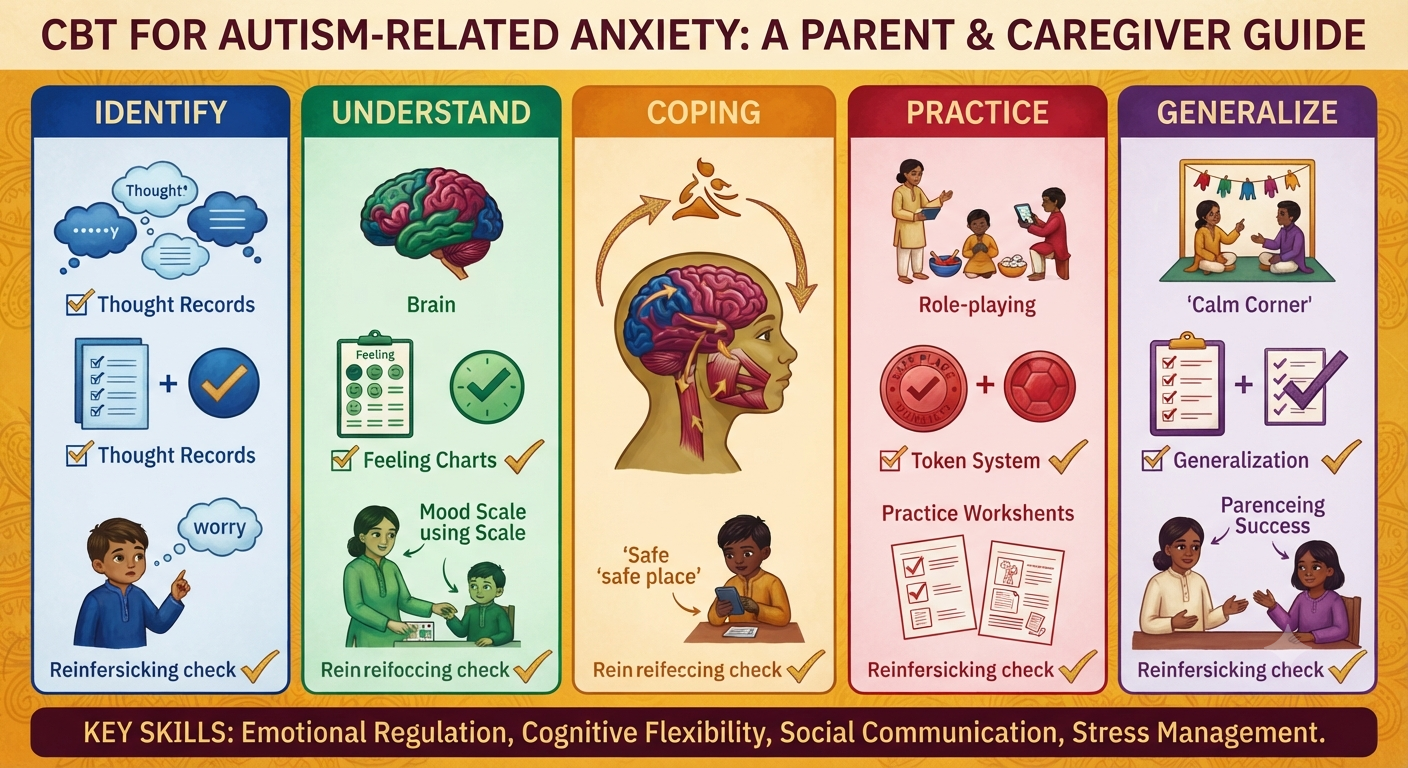
Below is a deep, structured, and practical explanation of CBT for autism-related anxiety, written for parents, educators, and therapists. This reflects how CBT is actually adapted for autistic children, adolescents, and even adults.
1️⃣ First, an important clarification
👉 CBT does NOT treat or change autism.
👉 CBT is used to reduce anxiety, emotional distress, and rigid thinking that often co-occur with autism.
Autism = neurodevelopmental condition
Anxiety = emotional/mental health condition
CBT targets anxiety, not autism itself.
2️⃣ Why anxiety is very common in autism
Autistic individuals experience anxiety more frequently because of:
🔹 Neurological reasons
-
Over-responsive nervous system
-
Difficulty filtering sensory input
-
Strong need for predictability
🔹 Cognitive reasons
-
Literal thinking
-
Difficulty with uncertainty
-
Black-and-white thinking
🔹 Environmental reasons
-
Social demands
-
School pressure
-
Sensory overload
-
Frequent misunderstandings
👉 Anxiety is often a logical response to a world that feels unpredictable.
3️⃣ How anxiety looks different in autistic children
Anxiety may NOT look like “I am scared”.
Instead, you may see:
-
Meltdowns
-
Shutdowns
-
Avoidance
-
Rigidity (“No change!”)
-
Repetitive questioning
-
Aggression
-
Somatic complaints (stomach pain)
CBT starts by recognizing these as anxiety signals, not “bad behavior”.
4️⃣ Why standard CBT needs adaptation for autism
Traditional CBT assumes:
-
Good emotional insight
-
Abstract thinking
-
Verbal expression
Many autistic individuals need:
✔ Concrete explanations
✔ Visual supports
✔ Slower pace
✔ Parent involvement
So CBT is modified, not removed.
5️⃣ Core CBT model (adapted for autism)
The basic CBT triangle is simplified:
Situation → Thought → Body feeling → Behavior
Example:
-
Situation: Change in routine
-
Thought: “This is wrong / unsafe”
-
Body: Tight chest, fast heart
-
Behavior: Meltdown or refusal
CBT teaches awareness of this chain.
6️⃣ Step-by-step CBT for autism-related anxiety
🧩 STEP 1: Psychoeducation (very concrete)
The child learns:
-
What anxiety is
-
That anxiety is a body alarm
-
That alarms can be too sensitive
Tools used:
-
Visual charts
-
Thermometer scales
-
Stories (“Anxiety as a smoke alarm”)
No abstract talk.
🧩 STEP 2: Emotional awareness (often missing skill)
Many autistic children struggle to label emotions.
CBT teaches:
-
Identifying body signals
-
Matching feelings to sensations
Examples:
-
Tight tummy = worry
-
Hot face = anger
-
Fast heart = fear
Tools:
-
Emotion cards
-
Body maps
-
Color coding
🧩 STEP 3: Identifying anxious thoughts (adapted)
Instead of “What are you thinking?”, CBT uses:
-
“What did your brain say?”
-
“What rule did your brain make?”
-
“What scary idea popped up?”
Common autistic anxiety thoughts:
-
“Rules must not change”
-
“I will do it wrong”
-
“People will be angry”
-
“I don’t understand this”
🧩 STEP 4: Cognitive restructuring (VERY concrete)
CBT does NOT force positive thinking.
It teaches balanced thinking.
Examples:
| Anxious Thought | Balanced Thought |
|---|---|
| “Change is bad” | “Change is hard but safe” |
| “I can’t” | “I can try with help” |
| “It must be perfect” | “Good enough is okay” |
Tools:
-
Thought cards
-
Visual scripts
-
Written rules
🧩 STEP 5: Coping skills training
CBT teaches what to DO when anxiety appears.
Skills include:
-
Deep breathing (visualized)
-
Counting
-
Sensory tools
-
Self-talk scripts
-
Break requests
Important:
✔ Skills are practiced before exposure
✔ Practiced daily, not only during anxiety
🧩 STEP 6: Gradual exposure (MOST important part)
Avoidance increases anxiety.
CBT gently teaches:
“I can face this in small steps.”
Exposure is:
-
Planned
-
Gradual
-
Supported
-
Never forced
Example (school anxiety):
-
Talk about school
-
Visit school gate
-
Stay 5 minutes
-
Stay 15 minutes
-
Attend class briefly
Each step paired with coping skills.
7️⃣ CBT techniques commonly used for autistic anxiety
🔹 Visual CBT tools
-
Fear ladders
-
Worry thermometers
-
Social stories
-
Checklists
🔹 Behavioral experiments
Testing beliefs:
-
“If I make a mistake, will people shout?”
-
Try → observe → discuss
🔹 Predictability supports
-
Schedules
-
Timers
-
Transition warnings
8️⃣ Parent role in CBT (CRITICAL)
Parents are not observers.
They help by:
-
Reducing reassurance-seeking
-
Encouraging coping skills
-
Avoiding over-protection
-
Supporting exposure
CBT trains parents to:
❌ Not rescue too quickly
✔ Support independence
9️⃣ CBT + autism therapies (best practice)
CBT works best when combined with:
-
Speech therapy (for expression)
-
OT (for sensory regulation)
-
ABA (for routines & behaviors)
CBT alone is rarely enough.
🔟 Who benefits most from CBT for autism-related anxiety
✔ Verbal children
✔ Adolescents
✔ High-functioning autism
✔ Asperger profile
✔ Adults with autism
Less effective for:
-
Very young children
-
Non-verbal children
-
Severe intellectual disability
(These may need behavioral & sensory approaches first.)
1️⃣1️⃣ What CBT does NOT do
❌ Remove autism traits
❌ Force eye contact
❌ Eliminate stimming
❌ Ignore sensory needs
Ethical CBT respects neurodiversity.
🌱 One-line summary
CBT helps autistic individuals understand their anxiety, manage their thoughts and body responses, and gradually face fears—without trying to change who they are.