



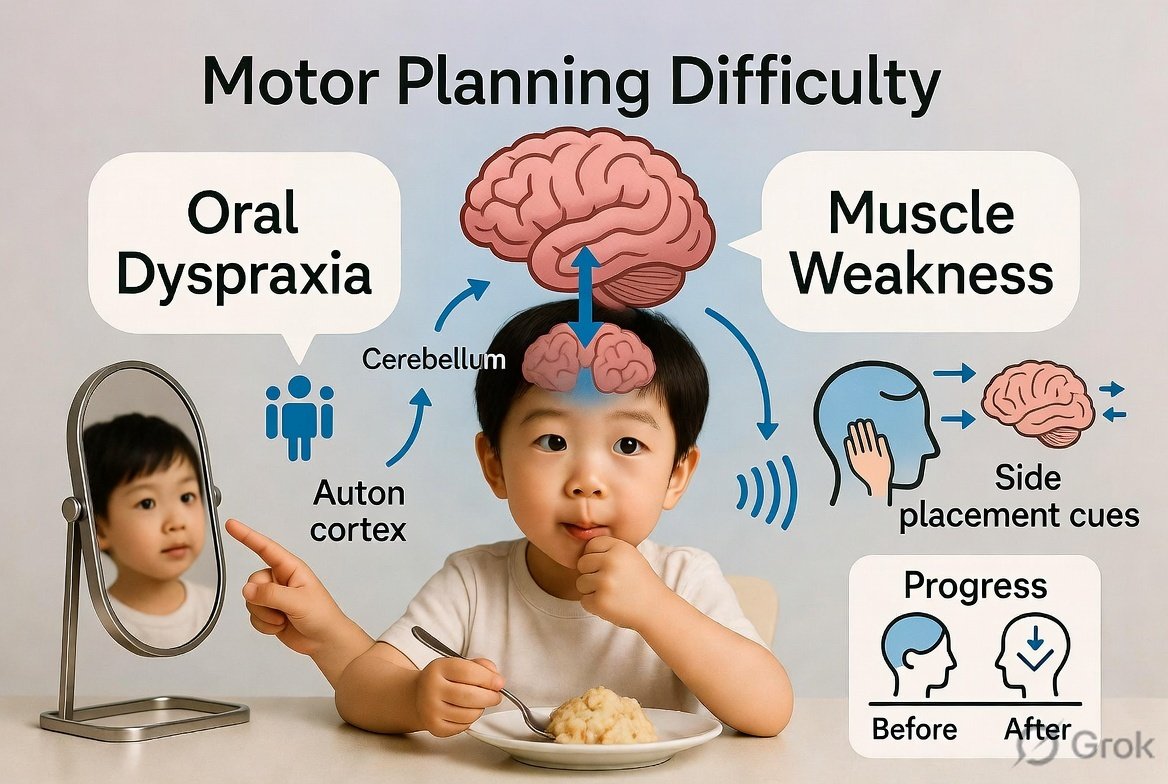
Motor Planning Difficulty in Chewing: Complete Speech and Feeding Guide
Understanding oral motor planning, signs, therapy support and parent safety
What is motor planning difficulty in chewing?
Motor planning difficulty in chewing means a child may struggle to organize and coordinate the jaw, tongue, lips and swallowing sequence needed to manage food. A qualified feeding professional should assess the child because similar signs can also have sensory, medical, dental, postural or swallowing-related causes.
Motor planning difficulty in chewing is clinically important and is often misunderstood. A child may want to eat and may have enough muscle strength, yet still struggle to sequence the oral movements needed to bite, chew, move food and swallow efficiently.
Safety first
Seek urgent medical help for severe choking, inability to breathe or cry, blue or grey colour, inability to clear an airway obstruction, significant breathing difficulty, dehydration or sudden loss of feeding skills. Repeated coughing, choking, weight loss, poor growth or respiratory symptoms also require prompt discussion with the child’s pediatrician.
Table of Contents
- What is motor planning?
- What is oral motor planning difficulty?
- Why it may happen
- Signs of difficulty in chewing
- Connection with speech
- What is happening in the brain?
- How therapy helps
- What improvement can look like
- Motor planning vs sensory feeding
- Clinical insight and prognosis
- Frequently Asked Questions
What Is Motor Planning?
Motor planning, sometimes called praxis, is the brain’s ability to:
- Think of a movement.
- Organize the movement or muscle sequence.
- Execute the movement smoothly and at the right time.
In feeding, the child’s body needs to coordinate:
- Jaw opening and closing.
- Tongue movement from side to side.
- Lip closure.
- Movement of food around the mouth.
- Timing of swallow.
When this coordination is difficult, chewing may appear inefficient, slow, inconsistent or unsafe. This does not automatically mean that the child has one specific diagnosis; feeding and swallowing difficulties require individualized assessment.
What Is Oral Motor Planning Difficulty?
In feeding therapy, clinicians may use terms such as:
- Oral dyspraxia.
- Feeding apraxia.
- Motor planning delay.
The child may recognize food and want to eat, but their brain may have difficulty sequencing the chewing movements in an organized way.
How it may differ from other difficulties
- Muscle weakness: A strength or endurance problem.
- Sensory sensitivity: Discomfort, avoidance or distress related to texture, smell, temperature or appearance.
- Behavioural refusal: A description of observable refusal, which may still have underlying sensory, medical, skill or anxiety-related causes.
Important clinical clarification
Oral motor planning difficulty may be one contributor, but feeding problems can also involve medical, nutritional, feeding-skill and psychosocial factors. A child can have more than one contributor at the same time. [web:163]
Why It May Happen
Motor planning difficulty can occur alongside:
- Immature or developing neural coordination.
- Developmental differences in coordination and connectivity.
- Speech motor-planning differences.
- Co-occurring neurodevelopmental conditions, including autism spectrum disorder or childhood apraxia of speech.
The child’s muscles may appear strong, but the movement pattern may be poorly timed, inconsistent or disorganized. Other possible contributors-such as sensory processing, posture, dental concerns, reflux, pain, fatigue or swallowing difficulty-should also be considered.
Signs of Motor Planning Difficulty in Chewing
Children with oral motor planning difficulty can appear “clumsy” or inconsistent with mouth movements. The following observations can help families describe concerns to a professional:
| Observation | What it may suggest |
|---|---|
| Chews only in the front of the mouth | Difficulty organizing side placement of food |
| Takes a very long time to chew | Poor sequencing, inefficient chewing or fatigue |
| Food falls out of the mouth | Difficulty with lip coordination or oral control |
| Chews but does not swallow efficiently | Breakdown in timing, food gathering or swallow preparation |
| Gags despite soft food | Possible tongue-movement, sensory, medical or coordination concern |
| Chews on one side only | Limited motor-planning flexibility, habit, discomfort or dental concern |
| Food remains in the cheeks | Difficulty moving food, oral residue or pocketing |
| Coughs or chokes during meals | Possible swallowing-safety concern requiring clinical assessment |
Do not ignore swallowing warning signs
Repeated coughing, choking, wet/gurgly sounds, breathing changes, food pocketing, long meals or weight concerns should be discussed with a qualified professional. ASHA identifies poor bolus control, poor oral management and slow or ineffective mastication among pediatric feeding-skill factors. [web:154]
Connection With Speech
Some children who have chewing motor-planning concerns may also show:
- Late speech development.
- Difficulty producing clear words.
- Inconsistent sound errors.
- Trouble imitating mouth movements.
Speech and chewing use some of the same oral structures, including the jaw, lips and tongue, but they are different functions. A child may have difficulty in one area without difficulty in the other. When both speech-motor and feeding concerns are present, a speech-language pathologist can help assess the child’s needs.
What Is Happening in the Brain?
Chewing depends on several brain-and-body systems working together. These include:
- Motor cortex: Supports voluntary movement.
- Cerebellum: Supports coordination, timing and adjustment of movement.
- Basal ganglia: Contributes to movement selection and sequencing.
- Sensory feedback loops: Provide information about food, pressure, movement and position in the mouth.
When signals are delayed, inefficient or difficult to coordinate, movements may appear:
- Jerky.
- Uncoordinated.
- Slow.
- Asymmetrical.
- Inconsistent from one bite to the next.
This section explains the general systems involved in movement. It does not identify a specific brain cause for an individual child; that requires appropriate clinical and medical assessment.
How Therapy Helps
Feeding therapy should be individualized and based on the child’s medical history, swallowing safety, posture, nutrition, sensory responses and functional feeding skills. Depending on the assessment, a qualified feeding professional may use the following approaches:
1. Repetition of a Correct Functional Pattern
The child practises safe, functional eating skills through structured and meaningful repetition. The aim is to build consistency while avoiding pressure, fatigue or unsafe textures.
2. Side Placement Practice
A clinician may teach safe placement of appropriate food on the chewing surfaces of the molars when this is suitable for the child. Families should use only the techniques and foods taught by the treating professional.
3. Slow, Controlled Chewing Practice
Some children benefit from pacing, bite-size adjustment, modelling or simple verbal cues. Counting chews may be used in selected plans, but it is not appropriate for every child and should not be used when swallowing safety is uncertain.
4. Visual, Tactile and Verbal Cues
Approaches may include mirror work, modelling, visual cues, verbal cues such as “chew on this side,” or carefully selected tactile cues delivered by a trained clinician. Parents should not attempt jaw guidance or place fingers/tools in the child’s mouth unless they have been specifically trained.
5. Gradual Texture Progression
Textures are advanced only when the child can manage them safely and comfortably. Difficult textures can overwhelm motor planning, sensory tolerance or swallowing skills, so progress should be individualized.
Evidence note
Evidence for pediatric oral sensorimotor interventions is still developing, and there is no single universally proven chewing protocol for every child. Functional, individualized therapy guided by qualified professionals is important. [web:161][web:166]
What Improvement Can Look Like
Early progress may include
- Chewing with less prompting.
- Fewer gagging episodes.
- Food being pocketed less often.
- Improved tolerance of safe and familiar textures.
- More comfortable and predictable mealtimes.
Later progress may include
- More independent use of both sides of the mouth when appropriate.
- More efficient chewing and swallowing.
- Improved management of clinician-approved mixed textures.
- Greater confidence and participation in family or school meals.
Progress is individual. It should be measured through functional goals such as safer eating, broader participation, improved nutrition, reduced distress and increased independence-not only by the number of foods eaten.
Difference: Motor Planning vs Sensory Feeding
Motor-planning and sensory feeding difficulties can overlap. The following comparison is a guide, not a diagnostic tool:
| Motor-planning / feeding-skill difficulty | Sensory-based feeding difficulty |
|---|---|
| Child may want to eat but struggle to organize bite–chew–move–swallow movements. | Child may avoid foods because of texture, smell, temperature, appearance or mixed sensations. |
| Mouth movements may look slow, uncoordinated or inconsistent. | Food presentation may trigger strong avoidance, distress or gagging. |
| Chewing pattern may vary from bite to bite. | Food preferences may be rigid or linked to predictable sensory characteristics. |
| May improve with modelling, functional skill practice and individualized cues. | May need gradual exposure, reduced pressure and individualized sensory support. |
| Can coexist with sensory, medical, nutritional or psychosocial concerns. | Can coexist with motor-planning, medical, nutritional or psychosocial concerns. |
Key Clinical Insight and Prognosis
Key clinical insight
Motor planning issues are not laziness, stubbornness or low intelligence. A child may need individualized support to build more organized movement patterns for eating. At the same time, similar signs can arise from sensory, medical, dental, postural or swallowing concerns, so assessment should consider the full picture.
Progress and prognosis: Improvement timelines vary widely. Some children show early changes such as fewer gagging episodes, less pocketing or more organized chewing with support. Others need longer-term multidisciplinary care. The child’s treating clinician can set realistic goals based on feeding safety, health, nutrition, sensory needs, development and family circumstances.
Parent safety reminder
Do not force chewing, advance textures, use oral-motor drills from the internet, place fingers or tools in the child’s mouth, or use jaw guidance without professional training. Seek prompt medical advice for coughing, choking, breathing changes, repeated gagging, weight loss, dehydration, persistent vomiting or loss of feeding skills.
Frequently Asked Questions
What is motor planning difficulty in chewing?
Motor planning difficulty in chewing means a child may struggle to organize and coordinate the jaw, tongue, lips and swallowing sequence needed to manage food. A qualified feeding professional should assess the child because similar signs can also have sensory, medical, dental, postural or swallowing-related causes.
What are signs of oral motor planning difficulty?
Possible signs include chewing only at the front of the mouth, taking a long time to chew, food falling out, pocketing food, chewing but not swallowing efficiently, gagging, using one side only and inconsistent mouth movements.
Is motor planning difficulty in chewing the same as sensory feeding difficulty?
No. Motor planning difficulty involves organizing and coordinating movement, while sensory feeding difficulty often involves strong discomfort or avoidance related to food texture, smell, temperature or appearance. Both may occur together.
Can parents use chewing drills at home?
Parents should only use strategies taught by the child’s qualified feeding professional. Do not force chewing, advance textures, place tools or fingers in the mouth, or use oral-motor exercises when swallowing safety is uncertain.
Trusted resources
For more information, see the ASHA Pediatric Feeding and Swallowing Practice Portal, the Children’s National overview of oromotor dysfunction, and the Royal Children’s Hospital feeding-difficulties resource.