



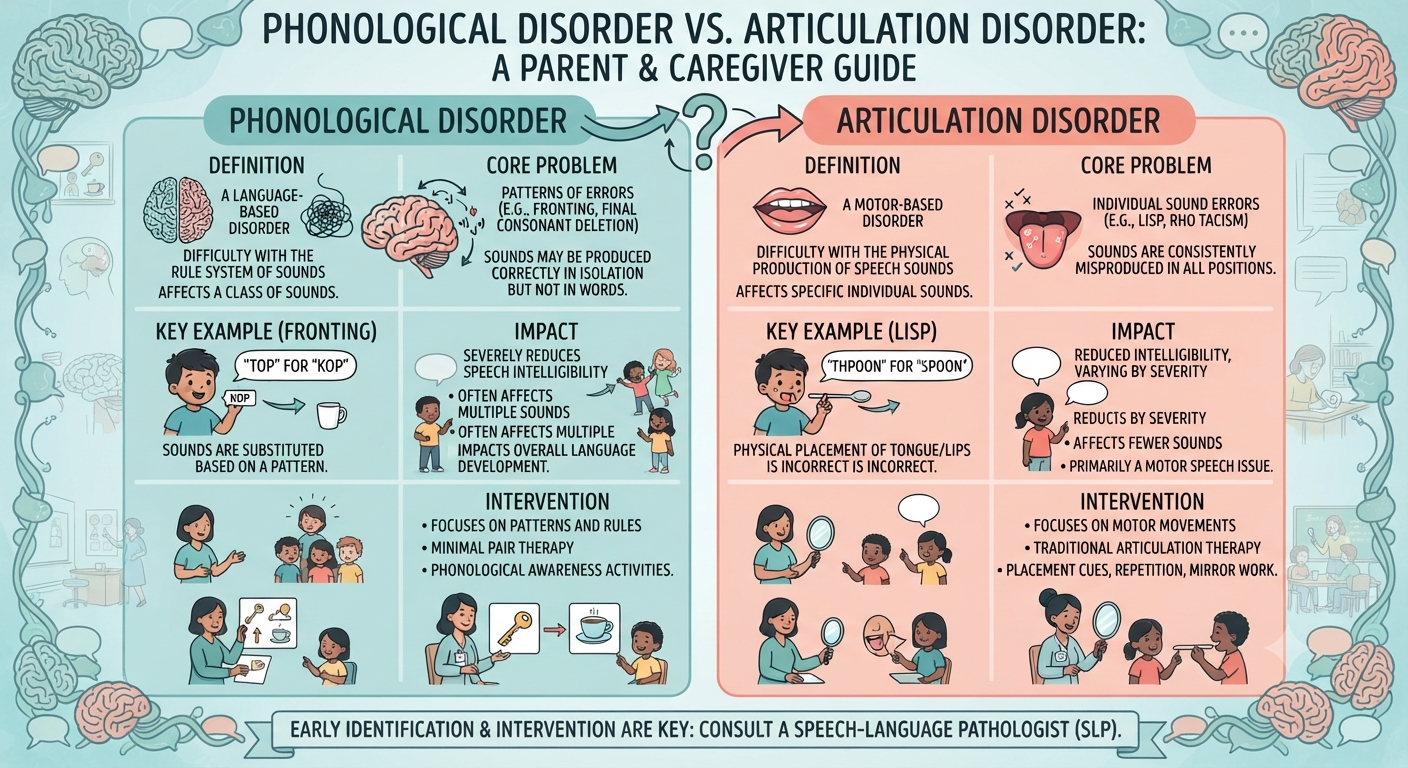
Phonological Disorder vs. Articulation Disorder
1️⃣ Big-picture difference (one line)
-
Articulation disorder → Problem making a sound correctly
-
Phonological disorder → Problem using sound rules correctly
👉 Articulation = HOW a sound is produced
👉 Phonology = WHEN & WHERE sounds are used
2️⃣ Articulation Disorder (Detailed)
What it is
A child knows the sound, but cannot physically produce it correctly.
The error is usually consistent.
Common signs
-
Substitution: “wabbit” for rabbit
-
Distortion: unclear /s/ (lisp)
-
Omission: “ca” for cat
-
Additions: “buhlue” for blue
Example
Child says:
-
“sun” → thun
-
“rice” → wice
🧠 Child understands the difference, but mouth placement is wrong.
Cause
-
Incorrect tongue/lip placement
-
Weak oral motor coordination
-
Habitual incorrect production
Therapy focus (Articulation)
✔ Teach correct placement
✔ Practice one sound at a time
✔ Drill from isolation → conversation
Therapy example
-
/s/ sound
-
Teach tongue behind teeth
-
“sss” → “sa” → “sun” → “The sun is hot”
3️⃣ Phonological Disorder (Detailed)
What it is
The child can make the sound, but uses it incorrectly in speech patterns.
The error follows a rule-based pattern.
Common phonological processes (patterns)
| Process | Example |
|---|---|
| Fronting | “tat” for cat |
| Final consonant deletion | “ca” for cat |
| Cluster reduction | “poon” for spoon |
| Stopping | “tun” for sun |
| Gliding | “wabbit” for rabbit |
Example
Child:
-
Can say /k/ in isolation
-
Says “tat” instead of cat
-
Says “tar” instead of car
🧠 Problem = sound system organization, not ability.
Cause
-
Immature sound system
-
Difficulty understanding sound rules
-
Developmental delay
Therapy focus (Phonological)
✔ Teach sound contrasts
✔ Target patterns, not single sounds
✔ Improve overall intelligibility
Therapy example
-
Target fronting
-
Contrast: “tea vs key”
-
Use minimal pairs: “tar vs car”
4️⃣ Key Comparison Table
| Feature | Articulation Disorder | Phonological Disorder |
|---|---|---|
| Main problem | Sound production | Sound system |
| Error type | Inconsistent or specific | Pattern-based |
| Sound isolation | Usually incorrect | Often correct |
| Number of sounds | 1–2 sounds | Many sounds |
| Intelligibility | Mild–moderate | Moderate–severe |
| Therapy style | Motor-based | Linguistic-based |
5️⃣ How to Identify Quickly (Clinical Tip)
Ask these questions:
-
Can the child say the sound alone?
-
❌ No → Articulation
-
✅ Yes → Phonological
-
-
Are errors consistent across many sounds?
-
❌ No → Articulation
-
✅ Yes → Phonological
-
6️⃣ Can a child have BOTH?
✅ Yes — very common
Example:
-
Lisp (/s/) → articulation
-
Fronting (/k/→/t/) → phonological
👉 Therapy addresses both, but separately.
7️⃣ Why correct diagnosis matters
-
Articulation therapy won’t fix phonological patterns
-
Phonological therapy won’t fix poor placement
-
Wrong approach = slow progress
8️⃣ Simple Parent-Friendly Summary
Articulation = mouth problem
Phonological = rule problem