



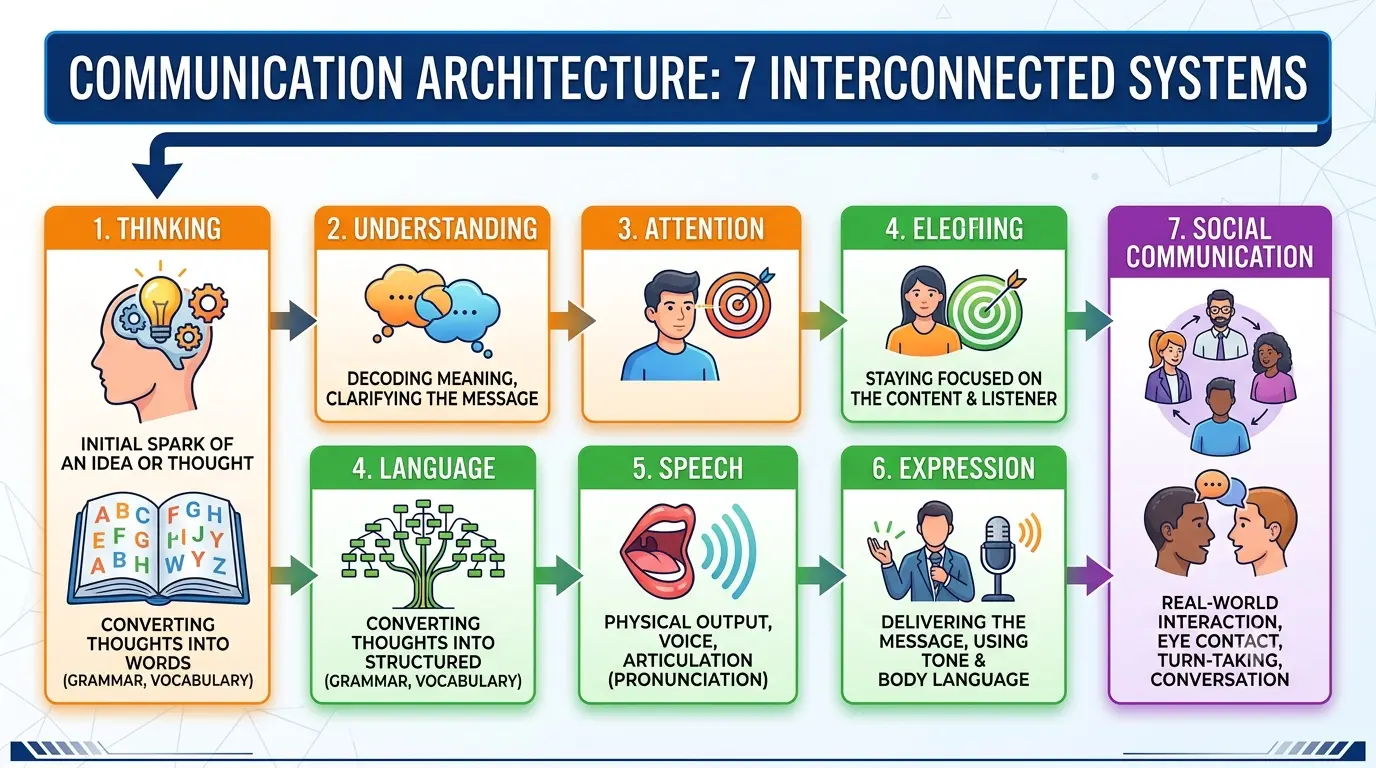
Understanding the 7 Systems of Communication Architecture is essential for speech therapists, educators, and parents supporting childhood development. Human communication is not just making sounds-it is a sophisticated, multi-tiered process that transforms an internal thought into a meaningful social exchange. Below is a comprehensive breakdown of the 7 systems of communication architecture that govern speech, language, and cognitive processing.
What is Communication Architecture? Communication architecture is the biological and cognitive framework consisting of seven interconnected steps: Thinking, Understanding, Attention, Language, Speech, Expression, and Social Communication (Pragmatics).
Overview of the 7 Systems of Communication Architecture
| System Phase | Core Domain | Primary Cognitive / Physical Function |
|---|---|---|
| 1. Thinking | Cognitive Initiation | The initial spark, idea, or feeling. |
| 2. Understanding | Cognition | Processing intent and contextual meaning. |
| 3. Attention | Executive Function | Focusing mental energy on the communication target. |
| 4. Language | Linguistic Encoding | Selecting vocabulary, grammar, and syntax. |
| 5. Speech | Motor Articulation | Physical sound production using vocal cords and mouth. |
| 6. Expression | Expressive Delivery | Vocal inflection, volume, and body language. |
| 7. Social Communication | Pragmatics | Eye contact, turn-taking, and joint attention. |
Deep Dive: Breakdown of the 7 Systems of Communication Architecture
1. Thinking (Intent & Ideation)
Every communication attempt begins in the mind. This phase represents the raw cognitive impulse-an emotion, memory, or reaction that creates the desire to convey a message to another individual.
2. Understanding (Cognitive Processing)
Before a thought can be spoken, the brain clarifies its purpose. The brain filters background noise and structures raw thoughts into coherent concepts. According to developmental standards outlined by the American Speech-Language-Hearing Association (ASHA), cognitive comprehension forms the foundation for all receptive and expressive language skills.
3. Attention (Executive Engagement)
Focus is the engine of communication. A speaker must maintain internal attention to sustain their train of thought, while simultaneously directing external attention toward the listener to gauge receptivity.
4. Language (Linguistic Encoding)
Language translates abstract thoughts into a structured code. This system operates across three distinct sub-levels:
- Semantics (Meaning & Context): Selecting the exact sense of a word.
- Syntax & Grammar: Arranging words into grammatically correct sentence structures.
- Lexicon (Vocabulary): Fetching the appropriate words from mental storage.
5. Speech (Physical Motor Articulation)
Speech is the physical execution of language. It requires precise motor control, coordinating breath support, vocal cord vibration, and the movement of the tongue, lips, and palate (articulation) to produce audible phonemes. Clinical research from the National Institute on Deafness and Other Communication Disorders (NIDCD) highlights how motor planning deficits can disrupt this specific stage.
6. Expression (Expressive Communication)
Expression enriches raw speech with emotional context. It encompasses vocal intonation, cadence, volume, facial expressions, and hand gestures that convey nuance beyond spoken words.
7. Social Communication (Pragmatics)
The final layer is pragmatics-using language appropriately in real-world social situations. Key elements include:
- Joint Attention: Sharing focus on the same subject with a communication partner.
- Turn-Taking: Mastering conversational rhythm (knowing when to speak vs. listen).
- Non-Verbal Cues: Maintaining natural eye contact and reading facial feedback.
Summary & Clinical Application
The progression across these systems moves seamlessly from Mental Processing (Thinking, Understanding, Attention) to Linguistic & Physical Execution (Language, Speech, Expression), concluding in Social Interaction (Pragmatics). A breakdown at any single stage can impact a child’s overall speech clarity or social development.
To learn more about environmental impacts on child speech, read our detailed guide on Speech And Language Development – Environmental Factors or explore our specialized Speech Therapy Resources.
Frequently Asked Questions about Communication Architecture
What are the primary components of communication architecture?
The primary components consist of 7 interconnected stages: Thinking, Understanding, Attention, Language, Speech, Expression, and Social Communication (Pragmatics).
How does speech differ from language in communication architecture?
Language is the internal cognitive code (vocabulary, grammar, semantics), whereas Speech is the physical motor output (vocal cord vibration, tongue placement, sound production).