



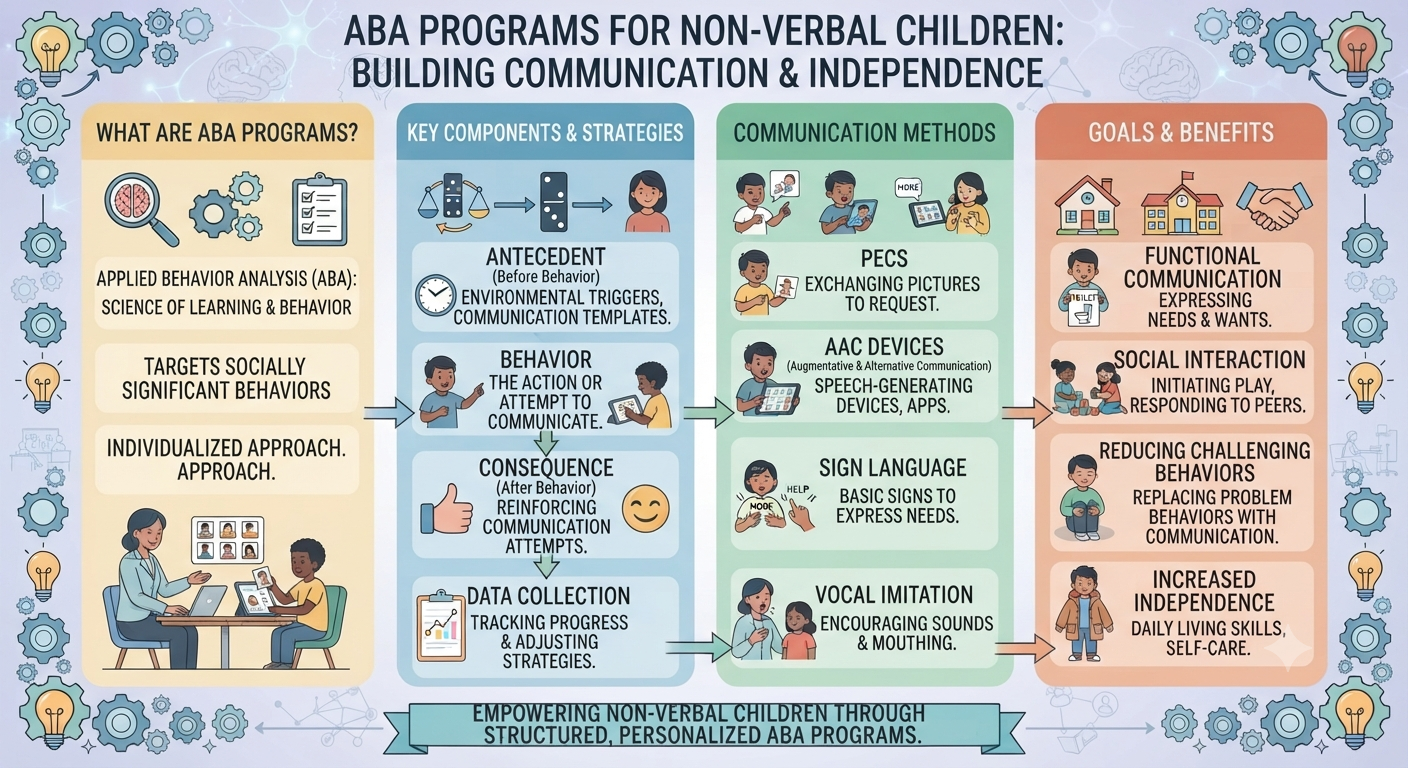
ABA Programs for Non-Verbal Children: Communication Guide
Functional communication, AAC access, realistic expectations and respectful questions to ask a provider.
What are communication-focused ABA programmes?
Communication-focused ABA programmes use individualized behavioural teaching to support meaningful communication and participation. They may incorporate functional communication training and collaborate with speech-language services. They are not substitutes for AAC assessment, do not require speech as the only response and cannot guarantee communication or spoken-language outcomes.
Communication access is a need, not a reward. No child should have to speak, sit still, make eye contact or demonstrate “readiness” before being offered appropriate AAC.
ABA Programs for Non-Verbal Children: Quick Overview
| Approach | Potential role | Important limit |
|---|---|---|
| FCT | An accessible message serving an assessed function. | Not a full language system or a substitute for medical assessment. |
| AAC | Gestures, signs, boards and speech-generating systems. | No prerequisites; choose access and vocabulary individually. |
| PECS | A specific structured picture-exchange protocol. | Not synonymous with all picture communication or required before a device. |
| Play and partner support | Meaningful communication opportunities in everyday activity. | Participation and choice matter; eye contact is not a prerequisite. |
| Outcome review | Independent messages, refusal, connection and daily participation. | No guaranteed speech or communication outcome. |
1. Understand the Child’s Communication Profile
“Non-verbal” is widely used, but some families and individuals prefer “nonspeaking” because limited speech does not mean an absence of language or communication. Others use “minimally speaking.” Use the terminology the individual or family prefers.
A child may communicate through gestures, facial expressions, movement, sounds, signs, pictures or writing. Do not assume low intelligence, no understanding or a future speech outcome from the absence of spoken words. Understanding also needs assessment rather than an assumption that every child understands everything.
2. Prioritize Communication Beyond Requests
ABA Programs for Non-Verbal Children should be evaluated by the usefulness of their goals, not by whether the child sits quietly or follows every instruction. Meaningful goals can include asking, refusing, commenting, sharing interests, expressing pain and connecting with others.
- Keep a reliable way to communicate available throughout the day.
- Accept existing gestures and other meaningful attempts.
- Include “no,” “stop,” “help,” “pain” and “break,” not only “more.”
- Respect preferences and signs of assent or distress.
Do not withhold meals, drinks, toileting, comfort, necessary breaks or communication devices to obtain a word or a particular response.
3. Functional Communication Training: Purpose and Limits
Functional communication training (FCT) teaches an accessible communication response that serves the same relevant function as an assessed behaviour. It is a specific intervention, not a label for all language teaching.
For example, when assessment supports that a difficult task is contributing to distress, the team may teach an accessible break request while also adapting the task. Crying alone does not establish “wants a toy,” and pulling an adult can already be meaningful communication.
Research reviews support FCT for selected communication and behavioural goals, but success in everyday settings and maintenance require deliberate planning. FCT does not replace a broad language and AAC plan.
ABA Programs for Non-Verbal Children must also consider pain, sensory overload, sleep, anxiety and environmental barriers. Not all distress results from communication failure.
4. AAC Is Available Without Prerequisites
Augmentative and alternative communication (AAC) includes unaided methods such as signs and aided methods such as picture boards or speech-generating devices. AAC is not exclusively an ABA method and is not reserved for children with apraxia or poor imitation.
ASHA states that AAC intervention has no prerequisites. A child does not need to prove readiness through matching, sitting, imitation or a certain IQ.
Match the system to the child
An SLP with AAC expertise can assess language, motor access, vision, hearing, sensory preferences and communication settings, working with OT or other professionals when appropriate. A single-message button may meet a specific need but is not necessarily a sufficient language system.
Partners can model messages on AAC without demanding immediate copying. Provide vocabulary for more than obtaining objects, and keep access available beyond formal teaching sessions.
5. PECS, Picture Boards and Gestures Are Different Options
PECS
The Picture Exchange Communication System is a specific structured protocol, not a generic name for picture communication. Its six phases cover physical exchange, distance and persistence, picture discrimination, sentence structure, responding to a request question and commenting. This outline is not an implementation manual.
Do not select PECS automatically or claim it is best for every child. Discuss whether its demands and vocabulary suit the child, and compare alternatives. Not every child needs to complete picture exchanges before accessing a speech-generating device.
Signs, gestures and picture boards
These may be useful independently or alongside a device. Adapt movements to access needs and ensure communication partners understand them. Do not require a perfect sign before responding.
AAC can supplement speech or serve as a long-term communication method. It does not have to be treated as a temporary bridge to a “better” form of communication.
6. Play, Understanding and Shared Attention
Some ABA Programs for Non-Verbal Children include naturalistic teaching during preferred activities. Shared play can create opportunities to communicate, understand language and take turns, but these skills should not become prerequisites for AAC.
- Model useful language during an activity the child enjoys.
- Allow time to process and respond without repeated testing.
- Follow the child’s interests and offer genuine choices.
- Support shared attention without demanding eye contact.
Imitation may be a useful goal for some children, but speech does not follow one compulsory sequence. Blowing, lip exercises and other nonspeech oral movements are not established general treatments for speech production. Speech goals need appropriate SLP assessment.
7. Address Unsafe Behaviour Without Suppressing Identity
Self-injury, aggression or unsafe wandering may require assessment and a safety plan. The plan should describe risks, medical considerations, environmental adjustments and accessible communication—not simply remove a behaviour.
Do not target harmless stimming, lack of eye contact or an unusual play style solely to make a child appear less autistic. Goals should relate to safety, access, well-being or priorities meaningful to the child.
This guide does not provide a home extinction, restraint or punishment protocol. If serious injury or immediate danger occurs, seek emergency help rather than continuing a teaching procedure.
8. What an Individualized Session Might Include
There is no universal sixty-minute schedule or required therapy intensity in this guide. Activity length, breaks and total services should reflect assessed needs, tolerance, family priorities and ongoing review.
A flexible session might include settling in, child-chosen play, partner modelling of AAC, a manageable learning opportunity, breaks when needed and caregiver discussion. Communication remains available throughout, not only during an “AAC block.”
“Play-based” or “child-led” is not a guarantee of quality. Check whether the child can decline, whether discomfort is noticed and whether the goals matter outside therapy.
9. Set Realistic Expectations About Speech
ABA Programs for Non-Verbal Children cannot guarantee speech, communication or a particular rate of progress. Some children develop spoken language; others continue to rely substantially on AAC. Both can have meaningful communication goals.
An AAC systematic review found no evidence that AAC impedes speech, while reported speech gains were often modest. Speech should not be promised as the reward for choosing a communication system.
Evaluate spontaneous messages, ability to refuse or ask for help, range of communication partners and meaningful participation. More correct responses in a session do not automatically mean broader language independence.
10. Choose a Coordinated Team and Review the Plan
There is no single ABA-plus-speech-plus-OT “gold standard” combination for every child. Services should address actual needs and avoid unnecessary burden or conflicting goals.
- An SLP assesses language, speech and AAC needs.
- A qualified behavioural clinician may assess behaviour and support agreed communication or learning goals within their competence.
- An OT may support motor access, environmental adaptations and everyday participation when indicated.
- Caregivers and educators help make communication accessible across daily life.
Neither SLP care nor AAC requires a child to start ABA first. A multidisciplinary plan should make responsibilities clear and include the child’s preferences.
Questions to ask providers
- How were goals chosen, and can the child decline an activity?
- Who assessed the AAC system, and is it available all day?
- How will prompts be reduced without removing needed access support?
- How are distress, pain and adverse effects recognized?
- What would lead us to change or stop this approach?
Persistent distress, ignored refusals, forced speech or removal of communication access warrants immediate review. Crying is a signal to understand and respond to—not something to dismiss as an inevitable stage of treatment.
Frequently Asked Questions
Can ABA guarantee speech or communication?
No. No programme can guarantee speech or a particular communication outcome. A plan should provide accessible communication options now, set meaningful individualized goals and review benefits, burdens and progress over time.
Does a child need prerequisite skills before AAC?
No. AAC has no required age, IQ, imitation or speech prerequisite. An SLP can assess access needs and help select and adapt a system while supporting existing gestures, sounds and other communication.
Will AAC prevent my child from speaking?
Available evidence does not show that AAC prevents speech development. It can support communication and may support speech for some children, but spoken-language gains vary and should not be promised.
Is PECS the same as any picture board?
No. PECS is a specific structured picture-exchange protocol. A picture board is another form of AAC and does not automatically follow PECS. The best option depends on the individual’s access, language and communication needs.
Sources and Further Reading
- ASHA: Augmentative and Alternative Communication
- ASHA National Joint Committee: AAC and prerequisites
- Systematic review: AAC and speech production in autistic children
- NICE: Individualized social-communication interventions
- ASAT: Functional Communication Training