



Applied Behavior Analysis ABA Therapy – Complete Parent Guide
Last Updated: October 6, 2026 | Reading Time: 10-12 minutes | For: Parents, caregivers, and educators
What is Applied Behavior Analysis ABA Therapy?
Applied Behavior Analysis ABA therapy is a research-based behavioral treatment that uses learning principles to increase positive behaviors and decrease negative behaviors. It’s considered the gold-standard intervention for autism spectrum disorder, helping children develop communication, social, and daily living skills through positive reinforcement.
📋 Table of Contents
Applied Behavior Analysis ABA therapy is widely recognized as the most effective, evidence-based treatment for autism spectrum disorder. This comprehensive guide explains what ABA is, how it works, the techniques used, and how parents can support ABA strategies at home.
Whether you’re a parent newly diagnosed with autism, an educator, or a caregiver, understanding Applied Behavior Analysis ABA therapy can help you make informed decisions about your child’s treatment and development.
💡 Quick Fact:ABA therapy is endorsed by the U.S. Surgeon General, the American Psychological Association, and the American Academy of Pediatrics as an effective treatment for autism.
What is Applied Behavior Analysis?
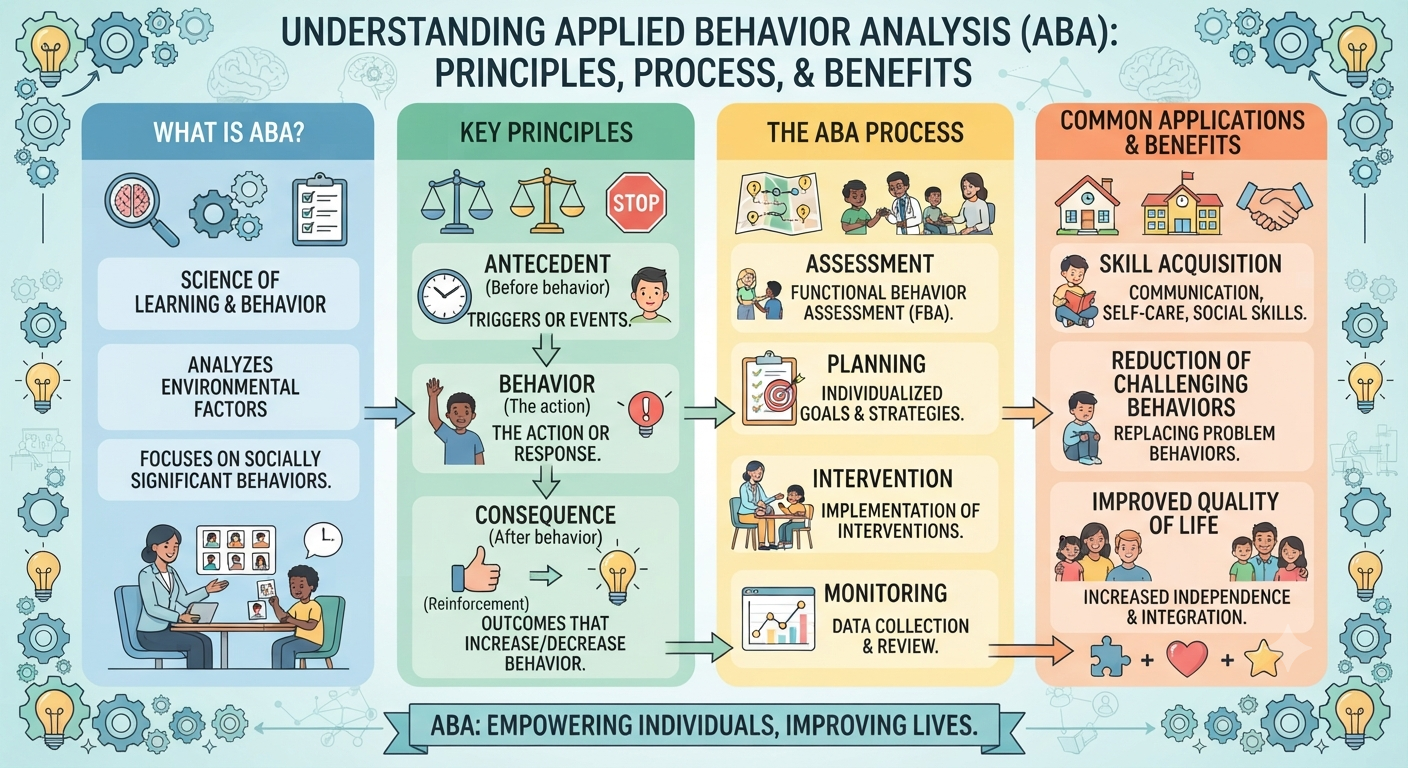
Applied Behavior Analysis (ABA) is a type of research-based behavior therapy that focuses on understanding and changing behavior through learning principles. The goal is to increase helpful behaviors while decreasing behaviors that may be harmful or interfere with learning.
Core Principles of ABA
- Positive Reinforcement: Rewarding desired behaviors to increase their occurrence
- Antecedent-Behavior-Consequence (ABC): Understanding what happens before, during, and after a behavior
- Data-Driven: Progress is measured and tracked systematically
- Individualized: Programs are tailored to each child’s unique needs
- Generalization: Skills are taught across different settings and situations
✅ Key Point:Applied Behavior Analysis ABA therapy is based on the science of learning and behavior. It helps children understand how their actions lead to consequences, making it easier to learn new skills and reduce challenging behaviors.
How Does ABA Therapy Work?
ABA therapy works by breaking down complex skills into small, manageable steps. Each step is taught systematically using evidence-based techniques, with consistent reinforcement for progress.
The ABC Model of Behavior
| Component | What It Means | Example |
|---|---|---|
| Antecedent (A) | What happens right before the behavior | Parent asks child to clean up toys |
| Behavior (B) | The action or response | Child throws toys and cries |
| Consequence (C) | What happens after the behavior | Parent removes the demand (child avoids cleaning) |
By analyzing the ABCs, therapists can identify patterns and develop strategies to encourage positive behaviors while reducing challenging ones.
Key ABA Techniques and Methods
Several evidence-based techniques are used in Applied Behavior Analysis ABA therapy. Here are the most common ones:
1. Discrete Trial Training (DTT)
- Highly structured, one-on-one teaching method
- Skills are broken into small “discrete” steps
- Each trial has: Instruction → Response → Consequence
- Example: Teaching colors by showing red card, asking “What color?”, rewarding correct answer
2. Natural Environment Training (NET)
- Teaching occurs in natural settings (home, playground, school)
- Uses child’s interests and motivations
- More flexible and child-led than DTT
- Example: Teaching “open” when child wants to open a toy box during play
3. Pivotal Response Treatment (PRT)
- Focuses on “pivotal” areas like motivation, self-management, initiation
- Child-directed, play-based approach
- Targets behaviors that produce broad improvements
- Example: Teaching child to initiate conversations during favorite activities
4. Positive Reinforcement
- Rewarding desired behaviors immediately
- Rewards can be: praise, toys, activities, tokens, edibles
- Reinforcement is gradually faded as skills develop
- Example: Giving sticker when child shares toys with sibling
5. Prompting and Fading
- Providing hints or assistance to help child succeed
- Types: physical, verbal, visual, gestural prompts
- Prompts are gradually reduced (faded) over time
- Example: Initially holding child’s hand to wave, then just touching elbow, then just verbal cue “wave”
6. Task Analysis and Chaining
- Breaking complex tasks into smaller steps
- Teaching steps in sequence (forward or backward chaining)
- Example: Brushing teeth broken into 10 steps, taught one at a time
ABA Techniques Overview
| Technique | Best For | Structure Level | Setting |
|---|---|---|---|
| Discrete Trial Training (DTT) | Teaching specific skills (colors, shapes, letters) | Highly structured | Clinic or table-based |
| Natural Environment Training (NET) | Generalizing skills to real-life situations | Moderately structured | Home, school, community |
| Pivotal Response Treatment (PRT) | Building motivation and initiation | Child-directed | Play-based, natural |
| Positive Reinforcement | Increasing any desired behavior | Flexible | Any setting |
Benefits of ABA Therapy
Applied Behavior Analysis ABA therapy has been shown to produce significant improvements in multiple areas of development:
Communication Skills
- Increased vocabulary and language use
- Improved ability to express needs and wants
- Better conversational skills
- Reduced frustration from communication barriers
Social Skills
- Improved eye contact and joint attention
- Better turn-taking and sharing
- Increased peer interactions and friendships
- Understanding social cues and norms
Daily Living Skills
- Toilet training and self-care routines
- Dressing, feeding, and grooming independence
- Following routines and schedules
- Completing chores and responsibilities
Academic Skills
- Improved attention and focus
- Better pre-academic skills (colors, shapes, numbers)
- Increased task completion
- Classroom behavior management
Behavior Reduction
- Decreased tantrums and aggression
- Reduced self-injurious behaviors
- Less repetitive or stereotypic behaviors
- Improved emotional regulation
📊 Research Evidence:Over 30 years of research shows that intensive, long-term ABA therapy (20-40 hours/week) leads to significant gains in IQ, language, and adaptive behavior for many children with autism.
ABA Strategies Parents Can Use at Home
While professional Applied Behavior Analysis ABA therapy is essential, parents can reinforce learning at home with these strategies:
1. Use Positive Reinforcement Consistently
- Immediately reward desired behaviors (within 3-5 seconds)
- Choose reinforcers meaningful to your child (praise, toys, activities)
- Be specific: “Great job putting your toys away!” instead of just “Good”
- Gradually fade rewards as behavior becomes natural
2. Break Tasks into Small Steps
- Use task analysis for complex skills
- Example: “Get dressed” broken into: (1) Get shirt, (2) Put arms in, (3) Pull down, (4) Fix collar
- Teach one step at a time, master it, then add next step
- Use visual schedules or checklists
3. Create Predictable Routines
- Consistent daily schedules reduce anxiety
- Use visual timetables (pictures or words)
- Give warnings before transitions: “5 more minutes, then bath time”
- Practice routines at the same time each day
4. Use Visual Supports
- Picture schedules, choice boards, first-then boards
- Visual timers for transitions
- Social stories to explain expectations
- Written or pictorial step-by-step guides
5. Practice During Natural Routines
- Mealtime: Practice requesting, taking turns, trying new foods
- Bath time: Practice following directions, body part names
- Grocery store: Practice pointing, choosing, waiting
- Playtime: Practice sharing, turn-taking, requesting toys
6. Be Consistent Across Caregivers
- All family members should use same strategies
- Same words, same expectations, same rewards
- Share successful techniques with grandparents, babysitters, teachers
- Regular communication with ABA therapist
⚠️ Important:While home strategies are helpful, they should complement-not replace-professional ABA therapy. Work with a Board Certified Behavior Analyst (BCBA) to develop an individualized treatment plan.
How to Find a Qualified ABA Therapist
Finding the right professional for Applied Behavior Analysis ABA therapy is crucial for your child’s success:
Credentials to Look For
- BCBA: Board Certified Behavior Analyst (master’s level)
- BCaBA: Board Certified Assistant Behavior Analyst (bachelor’s level)
- RBT: Registered Behavior Technician (implements therapy under supervision)
Questions to Ask Potential Providers
- Are you certified by the Behavior Analyst Certification Board (BACB)?
- How many years of experience do you have with autism?
- What is your approach to parent training and involvement?
- How do you measure and track progress?
- Do you provide services in our home, clinic, or school?
- What is your availability and session frequency?
Red Flags to Avoid
- Guarantees specific outcomes (“Your child will talk in 3 months”)
- Uses punishment-based methods
- Doesn’t involve parents in treatment planning
- No data collection or progress tracking
- One-size-fits-all approach
📚 Related Resources on limitlesslearner.in
🔗 Trusted External Resources:
Frequently Asked Questions (FAQ)
Applied Behavior Analysis ABA therapy is a research-based behavioral treatment that uses learning principles to increase positive behaviors and decrease negative behaviors. It’s considered the gold-standard intervention for autism spectrum disorder, helping children develop communication, social, and daily living skills through positive reinforcement.
Main ABA techniques include Discrete Trial Training (DTT), Natural Environment Training (NET), Pivotal Response Treatment (PRT), positive reinforcement, prompting and fading, and task analysis. These methods help children learn communication, social, and daily living skills in structured and natural settings.
Yes, parents can use ABA strategies at home including positive reinforcement, breaking tasks into small steps, using visual supports, maintaining consistency, and practicing skills during daily routines. However, working with a qualified BCBA is recommended for comprehensive treatment and individualized planning.
Applied Behavior Analysis ABA therapy can help improve communication skills, social interactions, attention and focus, daily living skills, academic performance, and self-regulation. It can also reduce problem behaviors like aggression, self-injury, tantrums, and repetitive behaviors.
Research suggests intensive ABA therapy (20-40 hours per week) produces the best outcomes, especially for young children. However, the exact number of hours depends on the child’s age, needs, goals, and family circumstances. A BCBA will conduct an assessment and recommend an individualized treatment plan.
Many insurance plans, including Medicaid in most states, cover ABA therapy for autism. Coverage varies by plan and location. Contact your insurance provider to understand your benefits, and ask the ABA provider about billing and documentation requirements.
🎯 Final Takeaway:Applied Behavior Analysis ABA therapy is the most evidence-based, effective treatment for autism spectrum disorder. While professional therapy is essential, parents can reinforce learning at home through positive reinforcement, consistent routines, visual supports, and natural practice opportunities. Working with a qualified BCBA ensures your child receives individualized, effective treatment tailored to their unique needs.
This page was last updated on October 6, 2026. For the most current information on Applied Behavior Analysis ABA therapy, consult a Board Certified Behavior Analyst (BCBA) or healthcare provider.