



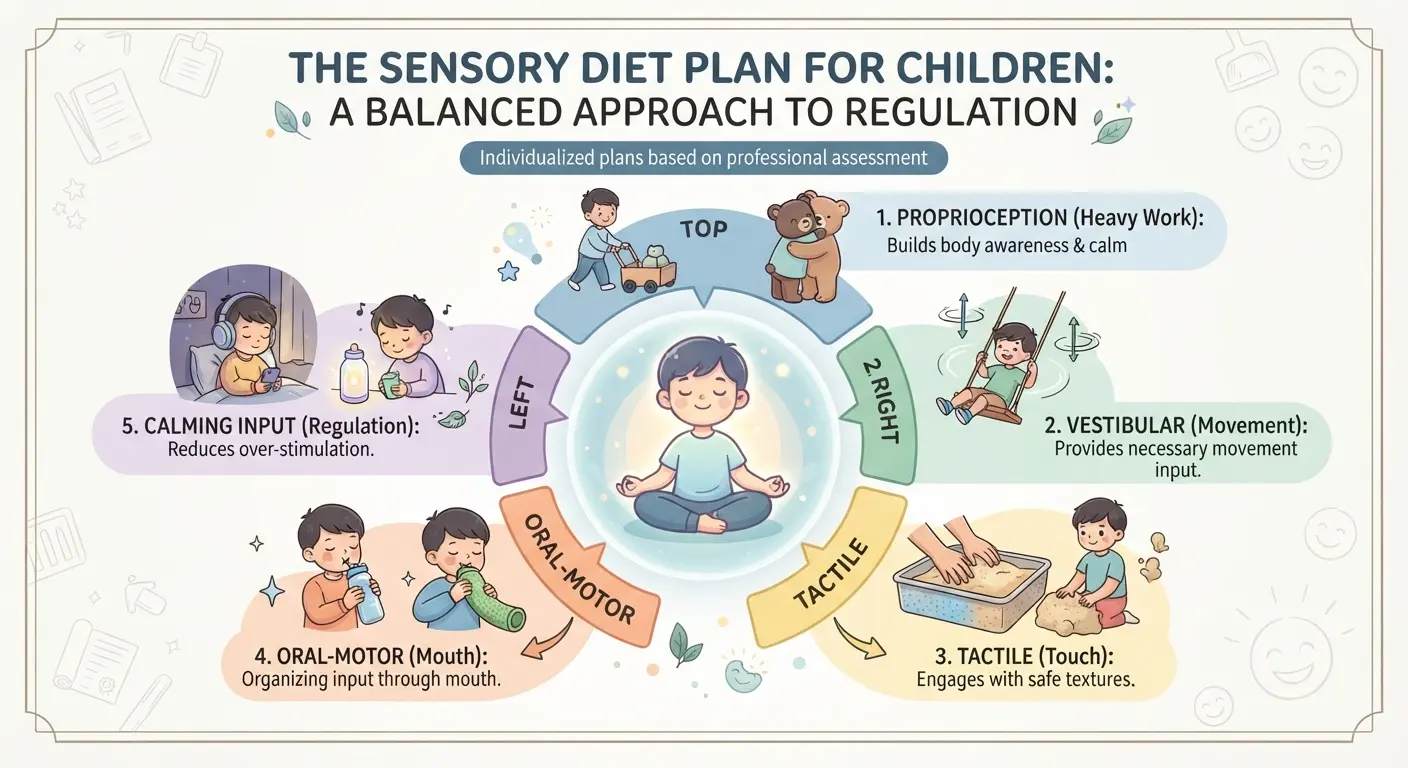
What Is a Sensory Diet Plan for Children?
A sensory diet plan for children is a personalized, scheduled activity plan designed by occupational therapists to supply the specific physical, visual, auditory, and tactile sensory input a child needs to stay calm, alert, and emotionally regulated throughout the day.
💡 Therapist Insight: A “sensory diet” does not involve food. Instead, it “nourishes” the child’s nervous system with structured physical inputs—such as heavy work, swinging, or deep pressure—at key intervals across their daily routine.
How to Build a Daily Sensory Diet Plan for Children
Every child has a unique sensory profile. Children who are hyper-sensitive (sensory avoiders) require calming routines, while hypo-sensitive children (sensory seekers) need organizing or alerting input. Integrating activities into morning, transition, and bedtime routines ensures consistent regulation.
Sensory Input Categories and Activity Examples
| Sensory System | Target Need | Therapeutic Activities | Recommended Timing |
|---|---|---|---|
| Proprioceptive (Heavy Work) | Grounding, calming & body awareness | Wall pushes, carrying heavy books, animal walks, weighted lap pads | Before focus tasks & during transitions |
| Vestibular (Movement) | Alerting under-aroused learners or calming seekers | Linear swinging, mini-trampoline jumping, slow rocking | Morning start & after-school decompression |
| Tactile (Touch) | Desensitization & emotional comfort | Play-dough squeezing, sensory bins (rice/beans), textured fidgets | Independent quiet play & calm-down periods |
| Oral Motor & Auditory | Oral regulation & noise buffering | Chewing rubber necklaces, drinking through thick straws, white noise | During mealtime, homework & bedtime |
Implementing Sensory Routines Across the Day
Clinical guidelines published by the American Occupational Therapy Association (AOTA) and research from the STAR Institute for Sensory Processing Disorder demonstrate that proactive sensory input prevents sensory overload far better than reactive interventions.
For children who struggle with chewable input or oral sensory seeking, combine your daily schedule with targeted exercises outlined in our guide on Chewing Oral Motor Difficulties: Signs, Causes & Therapy. For digital and classroom settings, you can also integrate interactive breaks from our collection of 50 Virtual Sensory Room Activities.
Sample Daily Sensory Diet Schedule
- Morning (Alerting & Grounding): 5 minutes on a mini-trampoline followed by drinking a smoothie through a thick straw to prepare for school.
- Mid-Morning (Focus Support): Seated resistance band stretches or wall push-ups before quiet reading time.
- After-School (Decompression): 15 minutes of outdoor linear swinging or heavy-work playground activities.
- Bedtime (Calming & Down-Regulation): Warm bath, dim lighting, heavy blanket massage, and soft white noise.
A Sensory Diet Plan is a structured schedule of sensory activities provided throughout the day to help children regulate their nervous system. The term was introduced by Patricia Wilbarger in the field of Occupational Therapy.
It is commonly used for children with sensory processing challenges such as Sensory Processing Disorder, Autism spectrum disorder, and Attention Deficit Hyperactivity Disorder.
A sensory diet does not mean food. It refers to a balanced “diet” of sensory input that helps the child stay calm, alert, and focused.
What is the Purpose of a Sensory Diet?
A sensory diet helps children:
- Regulate emotions
- Improve attention and learning
- Reduce tantrums and hyperactivity
- Improve body awareness
- Increase participation in daily activities
Children who do not receive the sensory input they need may become:
- restless
- aggressive
- anxious
- withdrawn
Types of Sensory Input in a Sensory Diet
| Sensory System | Function |
|---|---|
| Proprioceptive | Body awareness, muscle pressure |
| Vestibular | Balance and movement |
| Tactile | Touch sensations |
| Visual | Sight and visual processing |
| Auditory | Sound processing |
| Oral sensory | Mouth and chewing sensations |
Example Daily Sensory Diet Plan (School-Age Child)
| Time | Activity | Sensory Type | Purpose |
|---|---|---|---|
| Morning before school | Wall push-ups | Proprioceptive | Body activation |
| Morning | Deep breathing | Regulation | Calm focus |
| School break | Jumping or mini trampoline | Vestibular | Energy release |
| Mid-morning | Stress ball squeezing | Tactile | Improve attention |
| Lunch time | Chewy foods (carrot, apple) | Oral sensory | Jaw input |
| Afternoon break | Animal walks (bear walk, crab walk) | Proprioceptive | Muscle input |
| After school | Swinging or spinning play | Vestibular | Relaxation |
| Evening | Yoga stretches | Proprioceptive | Calm body |
| Night | Weighted blanket relaxation | Deep pressure | Better sleep |
Sensory Diet Activities List
Proprioceptive Activities (Heavy Work)
These are the most calming sensory activities.
- Wall push-ups
- Carrying books or bags
- Pushing chairs or tables
- Animal walks
- Tug of war
- Climbing playground equipment
- Jumping on trampoline
- Pulling resistance bands
Benefits:
- Reduces anxiety
- Improves attention
- Calms hyperactivity
Vestibular Activities (Movement)
These stimulate the balance system.
- Swinging
- Spinning slowly
- Rocking chair movement
- Jumping games
- Scooter board riding
- Dancing
Benefits:
- improves coordination
- supports balance
- regulates energy level
Tactile Activities (Touch)
- Playing with kinetic sand
- Finger painting
- Water play
- Playdough squeezing
- Textured sensory bins
- Brushing therapy
Benefits:
- improves sensory tolerance
- increases exploration
Oral Sensory Activities
Useful for children who chew objects or clothing.
- Chewing crunchy foods (carrot, apple)
- Blowing bubbles
- Using whistles or horns
- Drinking through straws
- Chewing gum (age appropriate)
Benefits:
- improves oral motor skills
- supports speech development
- provides calming effect
Visual Sensory Activities
- Watching bubble lamps
- Lava lamp visuals
- Star projector
- Calm nature videos
- Tracking moving objects
Benefits:
- relaxation
- visual attention
Auditory Sensory Activities
- Listening to nature sounds
- Soft instrumental music
- Rhythmic clapping games
- Sound matching games
Benefits:
- auditory processing
- emotional regulation
Signs a Child May Need a Sensory Diet
A sensory diet may help if a child:
- Constantly moves or fidgets
- Crashes into furniture
- Seeks spinning or jumping
- Covers ears frequently
- Avoids touch or certain textures
- Has frequent emotional meltdowns
- Struggles to focus in class
Tips for Creating a Sensory Diet
1. Provide Regular Sensory Breaks: Every 2–3 hours is helpful.
2. Mix Calming and Alerting Activities: Balance is important.
3. Observe Child Response: Every child’s sensory needs are different.
4. Start with Proprioceptive Activities: Heavy work activities are the most regulating.
Important Note
A sensory diet should ideally be designed by an occupational therapist trained in sensory integration therapy. However, parents and teachers can implement simple sensory activities at home or school with guidance.
Frequently Asked Questions
What is a sensory diet plan for children?
A sensory diet plan for children is an individualized routine of physical, tactile, and movement activities designed by an occupational therapist to help a child maintain a calm and focused nervous system.
How do I know if my child needs a sensory diet?
Children who frequently seek intense movement, crash into furniture, cover their ears at mild sounds, struggle with emotional regulation during transitions, or show extreme sensitivity to clothing textures often benefit from a sensory diet.
Can parents implement a sensory diet at home without a therapist?
While an occupational therapy assessment provides the best customization, parents can safely introduce basic heavy-work activities, tactile sensory bins, and scheduled movement breaks at home.
How long does it take to see results from a sensory diet?
When implemented consistently every day, many parents and teachers notice improvements in a child’s focus, emotional regulation, and sleep patterns within 2 to 4 weeks.