



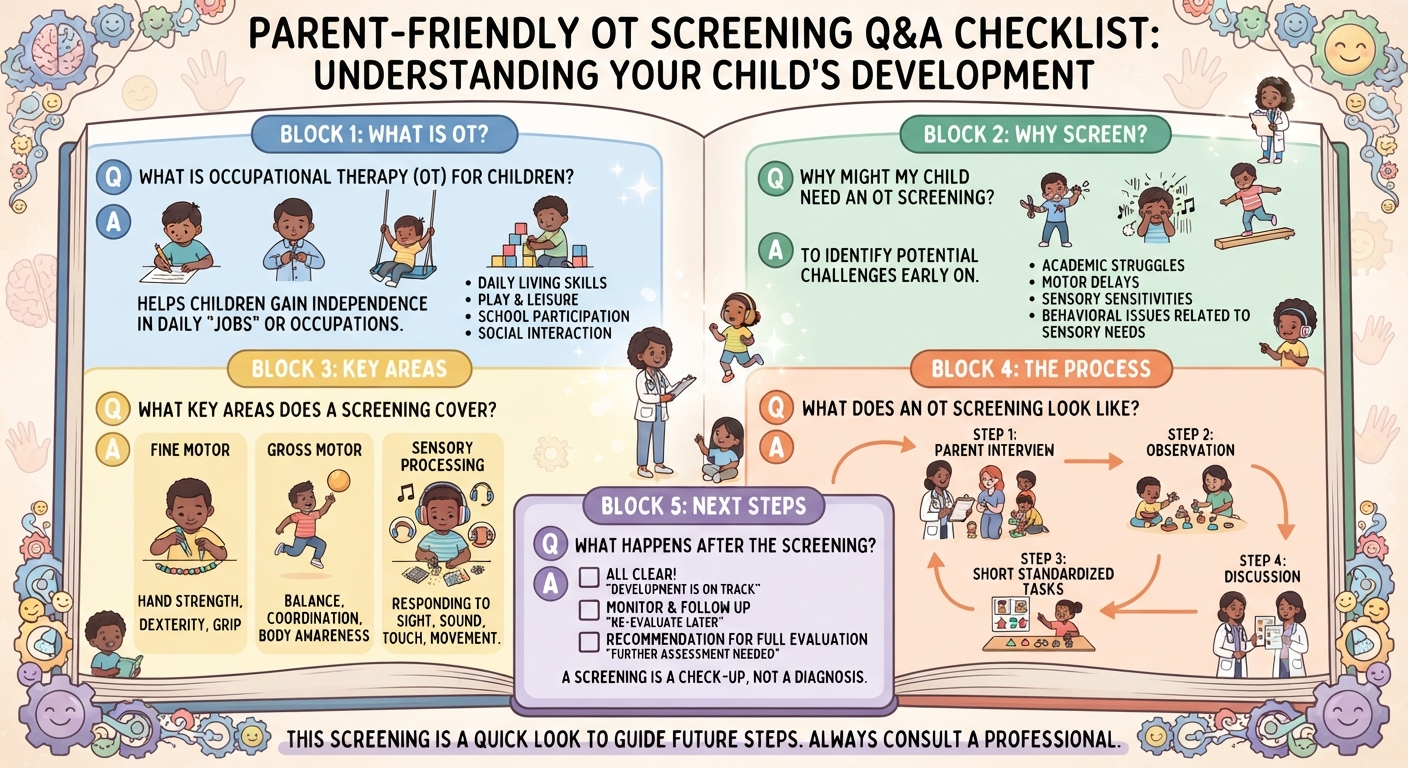
OT Screening Checklist: 6 Areas Parents Can Observe
An informal guide to everyday participation, sensory experiences and practical questions for your child’s care team.
What is an OT screening checklist?
An OT screening checklist gathers observations about a child’s participation in everyday activities, such as dressing, play and learning. This informal parent guide highlights questions to discuss with a professional; it is not a validated screening tool and cannot determine diagnosis, eligibility or treatment frequency.
No diagnostic score or automatic referral cutoff
Do not total the answers to decide “OT needed” or “regular sessions required.” No validated scoring system is provided for this checklist. One serious safety or participation concern may matter more than several mild preferences.
For background, read What Occupational Therapy Really Means.
OT Screening Checklist: Quick Overview
| Area | What to observe | Why context matters |
|---|---|---|
| Sensory experiences | Responses to touch, sound and movement. | Preferences alone do not establish a disorder. |
| Regulation | Distress, recovery and transitions. | Consider communication, pain, sleep and the environment. |
| Movement and posture | Comfort, endurance, falls and play. | Medical or physiotherapy input may also be needed. |
| Fine and visual-motor skills | Utensils, drawing, fasteners and construction play. | Compare with developmental expectations and opportunities. |
| Movement planning | Learning and carrying out unfamiliar actions. | An observation does not establish a diagnosis. |
| Daily living | Dressing, meals, hygiene and toileting. | Goals should reflect family priorities and the child’s needs. |
How to Use This OT Screening Checklist
For each question, record “yes,” “no,” “sometimes” or “not applicable.” Add a short real-life example instead of calculating a score.
- Consider the child’s age, developmental level and opportunities to learn the task.
- Note where the difficulty happens and how often.
- Describe the effect on comfort, safety, participation or family routines.
- Record strengths, preferences and supports that already help.
- Invite the child’s perspective using speech, gestures, pictures or their communication system.
A useful note is specific: “The clothing seam feels painful, so getting dressed takes a long time; a softer shirt helps.” This tells the professional more than a tick beside “sensory problem.”
1. Sensory Experiences and Everyday Participation
Touch and grooming
- Does your child find particular clothing or textures uncomfortable enough to interfere with dressing or play?
- Are haircuts, nail care or bathing regularly distressing, despite gentle preparation?
- Does light touch cause distress, and does this affect daily routines?
Sound
- Does your child often cover their ears or leave ordinary environments because sound feels uncomfortable?
- Does noise trigger significant distress or prevent participation?
- Is background noise making everyday tasks difficult?
Movement and body awareness
- Does your child frequently bump into people or objects in ways that affect safety?
- Does jumping, spinning or running create safety concerns or prevent participation in valued activities?
- Does your child often seek firm contact or pressure, and what effect does this have on comfort or participation?
Sensory preferences alone do not establish a disorder or an OT need. Record triggers, settings and what helps. Do not restrain movement, force exposure or apply pressure because of a checklist answer.
2. Regulation, Distress and Transitions
Questions to consider
- Does your child experience frequent or intense distress that disrupts daily life?
- Is it difficult to recover after becoming upset, even with supportive help?
- Are changes or transitions regularly distressing?
- Do these difficulties prevent participation in activities important to the child or family?
Explore the context rather than labelling distress as bad behaviour. Pain, fatigue, communication barriers, sensory overload and anxiety may all need consideration. OT may be one part of support, not the only service.
3. Movement, Endurance and Posture
Questions to consider
- Does sitting for an age-appropriate activity seem unusually tiring or uncomfortable?
- Does your child frequently lean or change position in a way that affects comfort or participation?
- Are falls frequent enough to raise safety concerns?
- Does your child avoid playground activities because they seem difficult, frightening or painful?
Posture differences alone are not a diagnosis. Pain, weakness, balance concerns or frequent falls may need medical or physiotherapy assessment as well as, or instead of, OT.
4. Fine-Motor and Visual-Motor Skills
Questions to consider
- Does using an age-appropriate spoon, crayon or pencil interfere with eating or learning?
- Is drawing or handwriting unusually effortful, painful or avoided when it is developmentally expected?
- Are buttons or zippers difficult relative to the child’s opportunities and developmental level?
- Are puzzles, construction play or drawing frustrating in ways that limit participation?
Record the task and the support needed. There is no single pencil grasp every child must use. Visual concerns, pain and limited learning opportunities should also be considered.
5. Learning and Planning New Movements
Questions to consider
- Does your child struggle to learn unfamiliar movement tasks despite appropriate teaching and opportunities?
- Are repeated demonstrations needed more than expected for the task and developmental level?
- Do new physical tasks cause frustration that limits participation?
- Does your child avoid movement games because planning the actions seems difficult?
These observations do not diagnose dyspraxia or developmental coordination disorder. An evaluation considers comprehension, attention, confidence, physical ability and experience as well as movement planning.
6. Daily Living Skills and Routines
Questions to consider
- Does dressing require more help than expected for the child’s developmental level and experience?
- Does using utensils or participating in meals remain difficult despite suitable support?
- Are toileting routines difficult or distressing?
- Does toothbrushing or hair care cause ongoing difficulty despite gentle adaptations?
Dependence is not automatically a disorder, and independence is not the only valid goal. Toileting pain, constipation, feeding or swallowing concerns and dental pain may require other healthcare input.
How to Interpret Your Observations
This OT Screening Checklist is not a validated instrument. There is no supported rule here that three sensory answers or eleven total answers establish an OT need.
| Observation | Reasonable next step |
|---|---|
| A mild preference without distress or activity restriction. | Respect the preference, offer suitable adaptations and discuss concerns if they persist. |
| Ongoing difficulty affecting dressing, learning, meals or play. | Discuss assessment with the child’s clinician or an appropriately qualified OT. |
| A serious safety concern or a loss of skills. | Seek prompt professional advice; do not wait for a high checklist total. |
Do not use “no” answers to dismiss a parent’s or child’s concerns. Support decisions depend on the whole picture, not how many boxes are checked.
Record examples for your appointment
| Field | What to record |
|---|---|
| Activity | What the child wants or needs to do. |
| Observation | What happens, where and how often. |
| Impact | Comfort, safety, participation and help required. |
| Existing support | Changes that help and activities the child enjoys. |
| Priority | What the child and family would most like to improve. |
What Happens After an OT Screening Discussion?
An occupational therapist may take an occupational profile: a history of daily activities, interests, contexts and priorities. Evaluation then explores the factors that support or hinder meaningful participation.
As appropriate, this may include caregiver interviews, activity observation, information from school and standardized assessments. Not every child requires every test or a sensory programme.
- Identify strengths and barriers during relevant everyday tasks.
- Agree on goals with the child and family.
- Consider environmental changes, task adaptations and skill-building.
- Recommend other professional input when the concern is outside OT’s scope.
- Decide whether ongoing OT is indicated and how progress will be reviewed.
The American Occupational Therapy Association describes evaluation as identifying what a person wants and needs to do, what they can do and the supports or barriers affecting participation.
The OT Screening Checklist cannot set session frequency. Advice, consultation, a home or school plan, ongoing therapy or referral elsewhere may be appropriate depending on the evaluation.
When to Seek Help Promptly
Do not wait for a checklist score if a concern is affecting safety or development. Contact the child’s healthcare professional promptly for lost skills, repeated unexplained falls, new weakness, pain, feeding concerns or distress that is substantially affecting daily life.
Sudden weakness, severe injury, inability to breathe, severe choking or immediate danger requires urgent medical help. A routine OT appointment is not an emergency service.
Frequent distress, sensory discomfort, self-care difficulty or attention concerns deserve assessment, but they do not automatically indicate an emergency or establish that OT is the only appropriate service.
Why early discussion helps
Raising concerns early can help families access assessment and appropriate support. Avoid promises such as “the earlier OT starts, the easier the brain adapts”: outcomes vary, and older children can also benefit from suitable support.
The CDC advises families to discuss developmental concerns and ask about developmental screening rather than waiting.
Frequently Asked Questions
Does this OT screening checklist diagnose a condition?
No. This is an informal observation guide, not a validated screening instrument or diagnostic test. It cannot diagnose autism, ADHD, a sensory condition or an occupational therapy need.
How many “yes” answers mean my child needs OT?
There is no validated cutoff for this checklist. Consider the child’s age, distress, safety and participation instead of a total score. A single significant concern can justify seeking professional advice.
What happens during a pediatric occupational therapy evaluation?
An occupational therapist discusses family priorities, observes relevant daily activities and may use standardized assessments. The evaluation identifies strengths, barriers and appropriate goals, referrals or support strategies.
Can occupational therapy help with meltdowns and sensory distress?
An OT may help identify activity demands, environmental barriers and supportive adaptations. Meltdowns and distress can have multiple causes, so medical, communication, sleep or mental-health assessment may also be appropriate.
Sources and Further Reading
- AOTA: Evaluation and assessment
- AOTA: What is occupational therapy?
- American Academy of Pediatrics: Occupational therapy
- CDC: Developmental milestones and validated screening
- CDC: Concerned about your child’s development?