



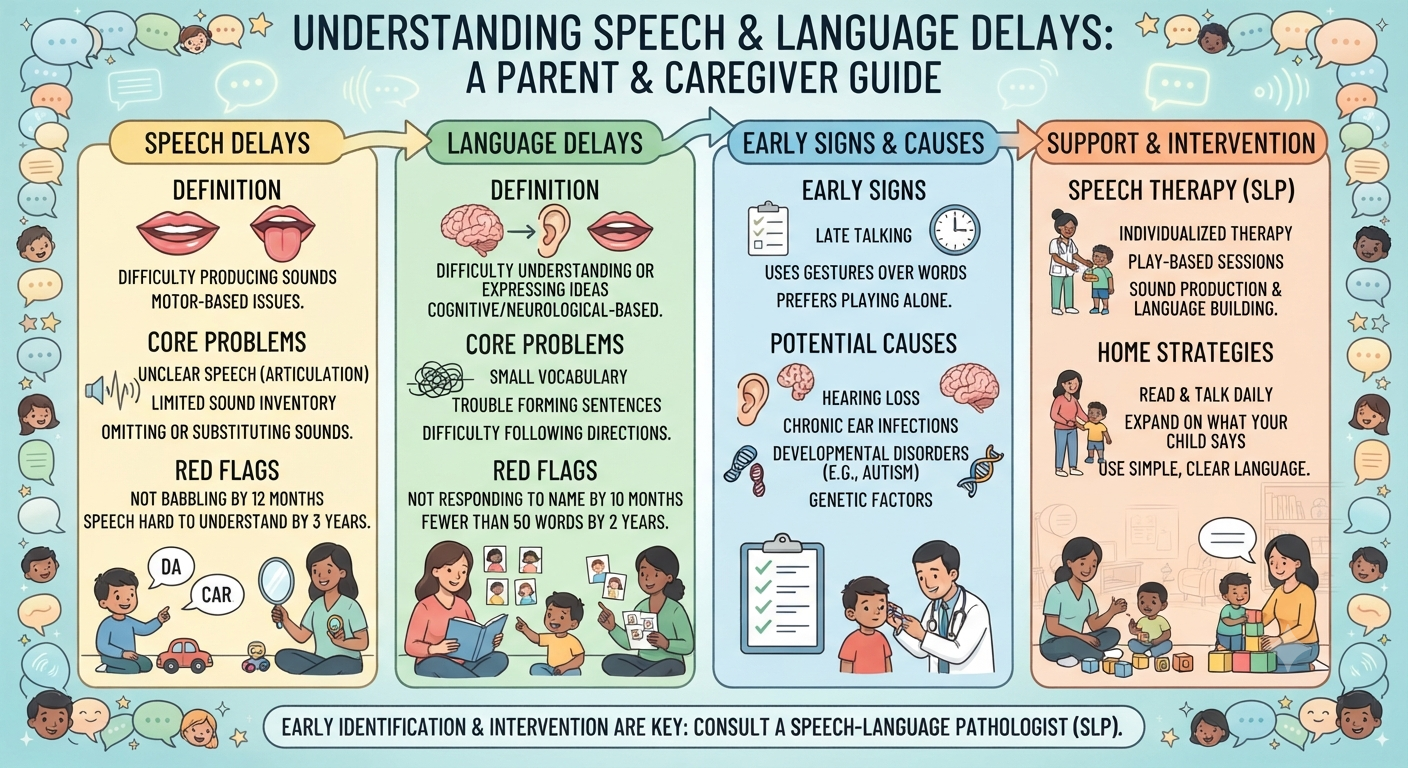
Speech and Language Delays: Signs, Assessment and Support
Understand communication development, recognize concerns and plan appropriate assessment without blame or guaranteed outcomes.
What are speech and language delays?
Speech and language delays describe slower-than-expected development in producing spoken sounds, understanding language or expressing meaning. A child may have concerns in one or several areas. Assessment considers hearing, development, everyday communication and all languages used; support is tailored to the individual.
This is an educational guide, not a diagnostic checklist. Discuss concerns early rather than waiting without a plan. Assessment does not automatically mean every child needs the same therapy.
Speech and Language Delays: Quick Overview
| Area | Possible concern | Important limit |
|---|---|---|
| Speech | Persistent sound-production or clarity difficulties. | Few words alone do not establish an articulation disorder. |
| Understanding | Difficulty understanding familiar messages in appropriate contexts. | Consider hearing, language exposure and task demands. |
| Expression | Limited vocabulary or combining of language. | Consider all languages and communication methods. |
| Hearing | Concerns about sound response or communication access. | A normal newborn screen does not resolve all later hearing concerns. |
| Development | Concerns involving play, gestures or loss of skills. | One sign does not diagnose autism or another condition. |
1. Speech and Language Are Different
Speech includes the production of spoken sounds and aspects such as fluency and voice. A speech sound difficulty may affect how accurately or clearly a child produces words.
Language involves understanding and expressing meaning. Receptive language includes understanding messages; expressive language includes sharing ideas, needs and information. Communication can involve speech, gestures, signs, writing or AAC.
Few spoken words do not automatically mean an articulation problem. Assessment should distinguish speech production, language development and communication access.
2. Age-Related Signs: Know Which Reference You Are Using
Speech and Language Delays cannot be diagnosed from a home checklist. Milestones guide discussion and do not replace validated screening or an SLP assessment.
| Age or range | Reference point | How to use it |
|---|---|---|
| Around 12 months | NIDCD describes one or two words by the first birthday within its communication checklist. | Discuss very limited babbling, gestures or sound response; assess the whole profile. |
| 18 months | CDC lists trying three or more words besides “mama” or “dada,” and pointing to share interest. | Do not present “10-20 words” as the CDC cutoff. Raise concerns even if one listed milestone is present. |
| 24 months | CDC lists combining at least two words. ASHA also describes a commonly used late-language-emergence criterion: fewer than 50 words and no two-word combinations at 24 months. | These are different reference purposes, not a reason to ignore a concern if one criterion is absent. |
| 30 months | CDC includes about 50 words and combining words with an action word. | This does not override clinical assessment criteria used at an earlier age. |
| 2-3 years | NIDCD describes growing vocabulary and two- or three-word phrases across this range. | Discuss persistent difficulty understanding messages, combining language or being understood. |
Assess communication across all languages. Eye contact alone is not a diagnostic test, and it should not be forced. Limited response to a name or sound can have several explanations and warrants appropriate hearing and developmental consideration.
For Speech and Language Delays, the most useful question is whether development and everyday communication are progressing—not whether a child can pass one isolated checklist item.
3. Possible Contributors and Associated Conditions
Hearing differences, speech sound disorders, developmental language disorder and other developmental or neurological conditions may be relevant. Prematurity and medical history can also inform assessment. Sometimes the cause is not clear.
Autism can involve communication differences, but speech delay alone is not diagnostic. Limited speech does not by itself indicate low intelligence. “Oral-motor weakness” should not be assumed without an appropriate examination.
Do not blame families or infer a cause from screen use alone. Responsive interaction and appropriate media routines matter, but developmental difficulties are not explained by a simple parenting label.
4. What Assessment May Include
- Caregiver concerns, medical history and development over time.
- Hearing screening or audiology assessment as appropriate, even if newborn screening was normal.
- Speech sounds, understanding, expression, play, gestures and social communication.
- Information about every language the child uses or hears.
- Observation in comfortable activities and accessible communication methods.
- Developmental screening or referral when broader concerns are present.
NIDCD notes that hearing testing is often included because hearing problems can affect communication development. An SLP and the child’s clinician can coordinate referrals.
For multilingual children, ASHA emphasizes assessment across languages to distinguish a language difference from a disorder.
5. When to Seek Advice Promptly
Raise concerns when a child has very limited sounds or gestures, no meaningful words by 18 months, difficulty combining words around two years, persistent comprehension concerns or communication that is substantially limiting participation.
Do not wait for a specific birthday if you are worried. Loss of previously acquired communication or other skills needs prompt medical review.
A developmental concern generally calls for timely assessment, not automatically an emergency visit. Sudden language loss with weakness, altered awareness, a seizure or other acute neurological signs requires urgent medical assessment.
6. Individualized Support and Therapy
Support for Speech and Language Delays may address speech production, understanding, expressive language, communication access or several areas together. Goals should reflect the child’s assessed needs and meaningful participation.
Some children need regular therapy; others may receive caregiver coaching and active monitoring with a review date. Follow-up is not the same as dismissive “wait and see.” Hearing or other medical concerns should be addressed alongside communication support.
AAC can provide additional communication access when needed and should not be reserved until speech therapy has failed. Ask an SLP about options rather than using speech as the only acceptable response.
7. Practical Family Strategies
- Follow the child’s interests and comment briefly on what you are doing together.
- Pause and respond to gestures, sounds, pictures or words.
- Expand a message naturally: “car” can become “car goes.”
- Share books, songs or pretend play in a comfortable way.
- Use the languages you know well; do not drop a home language because of a suspected delay.
- Protect time for interaction, sleep and play without treating every moment as a lesson.
“Talk more” does not mean nonstop narration, constant questions or demands to repeat. Keep communication responsive and allow processing time.
Speech and Language Delays are not a reason to force eye contact, withhold needed items until a word is spoken or compare a child with siblings. Useful communication matters more than performance on demand.
8. Progress and When to Begin
Seek advice as soon as a concern is noticed. Early assessment can identify needs and a suitable plan, but starting before age three or four does not guarantee an excellent outcome or create a deadline after which support cannot help.
ASHA reports that some children with late language emergence catch up, while others have ongoing language or literacy difficulties. Understanding as well as expression is relevant to prognosis; the evidence for that specific group should not be generalized to every child with a delay.
Review spontaneous communication, understanding, comfort and participation over time. Therapy duration and outcomes vary. The goal is appropriate support now, with planned reassessment—not a promise of a particular timetable.
Frequently Asked Questions
What is the difference between speech and language delays?
Speech concerns involve producing spoken sounds, while language concerns involve understanding or expressing meaning through words, sentences and other communication. A child can have difficulties in either or both areas. Assessment considers the child’s whole communication profile, not one milestone alone.
Does growing up with two languages cause language delay?
No. Multilingual development is not itself a cause of language disorder. Skills may be distributed across languages, so assessment should consider all the child’s languages and exposure rather than judge only one language.
Should parents wait for a child to catch up?
Raise concerns early with the child’s clinician or an SLP rather than waiting without a plan. Assessment may lead to therapy, caregiver strategies, hearing evaluation or active monitoring with scheduled review. Not every concern requires the same intervention.
Does a speech delay mean autism?
No. Communication difficulties can occur for several reasons, and speech delay alone does not establish autism. A developmental assessment may be appropriate when concerns also involve social communication, play, behaviour or other developmental areas.
Sources and Further Reading
- NIDCD: Speech and language developmental milestones
- NIDCD: Hearing and communicative development checklist
- ASHA: Late language emergence
- CDC: Milestones by 18 months
- CDC: Milestones by two years
- CDC: Milestones by 30 months