



Speech Delay vs Autism: Differences and Assessment
A careful comparison of communication needs, developmental patterns and appropriate next steps.
What is the main difference?
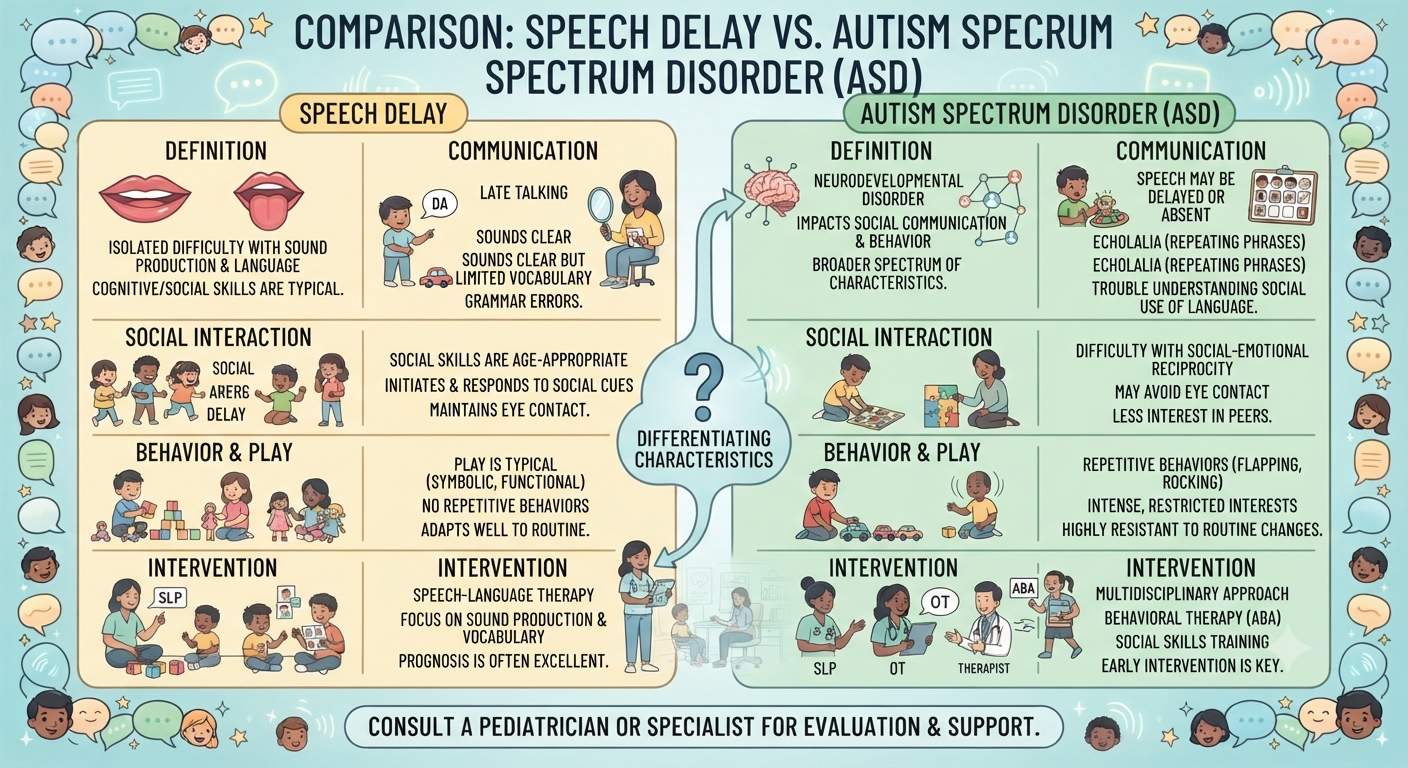
Speech delay describes concern about spoken communication development; autism involves a broader developmental pattern of social-communication differences and restricted or repetitive features. They can occur together, and autism can occur without delayed speech. A comprehensive assessment—not eye contact or one behaviour—helps distinguish the possibilities.
This comparison is not an autism screening tool or a diagnostic checklist. Good eye contact, affection and pretend play do not rule out autism, and limited speech does not establish it.
Speech Delay vs Autism: Comparison Table
| Area | Speech or language concern | Autism assessment context |
|---|---|---|
| Spoken language | Speech production and/or language development needs assessment. | Spoken language may be delayed, age-expected or advanced in some areas. |
| Social communication | May involve strengths and difficulties; a delay does not guarantee an otherwise typical profile. | Persistent social-communication and interaction differences form part of the diagnostic pattern. |
| Eye contact and affection | Vary with context, temperament and other factors. | Can be present; neither rules out autism. |
| Gestures and shared attention | Assess their use and developmental context. | May differ in frequency, integration or use; not uniformly absent. |
| Social interest and play | Consider opportunities, skills, preferences and communication access. | Autistic children can seek relationships, enjoy shared play and show affection. |
| Repetitive patterns and sensory features | Can occur for several reasons and are not diagnostic alone. | Restricted or repetitive patterns, interests or sensory features form the other diagnostic domain. |
| Understanding | May be stronger than expression or may also need support. | Varies substantially; do not infer understanding from speech level. |
| Echolalia | Repeated speech is not specific to autism. | May have meaningful communication or regulation functions. |
| Assessment | SLP and hearing evaluation, with broader referral as indicated. | Comprehensive developmental assessment, with communication and hearing considered. |
| Support | Selected according to the actual communication profile. | Individualized support for communication, health, participation and other needs—not a fixed therapy package. |
1. The Core Difference—and the Overlap
“Speech delay” is often used informally to mean late talking, but few words can reflect language development rather than articulation alone. An SLP can distinguish speech production, understanding and expressive communication.
Autism is a neurodevelopmental condition characterized clinically by persistent social-communication and interaction differences together with restricted or repetitive patterns of behaviour, interests or activities. Sensory features can be part of that second domain.
Speech delay is not required for autism. A child can have both, and fluent speech does not rule autism out. Speech Delay vs Autism is therefore not an either-or distinction.
2. Use Examples as Questions, Not Diagnostic Profiles
A child with limited spoken words
A child may point, enjoy playing with a caregiver and understand familiar messages while saying few words. This information helps describe strengths, but it does not establish a diagnosis or exclude broader concerns.
A child with fluent speech
Another child may use long sentences but experience difficulties with reciprocal communication, transitions or sensory demands. These concerns may justify assessment even without late speech.
Do not label an autistic child “socially disconnected.” Autistic people can want connection and show it in ways that others do not immediately recognize.
3. Concerns Worth Discussing
- Very limited gestures, words or accessible ways to express needs.
- Limited response to sound or a name, considering hearing and context.
- Concerns about sharing attention, interaction or participation across settings.
- Restricted or repetitive patterns together with wider developmental concerns.
- Persistent difficulty understanding familiar messages.
- Loss of previously acquired language, communication or other skills.
No single item diagnoses autism. Repetitive movements, a sensory preference or an isolated missed milestone can have several explanations. Harmless stimming should not be suppressed just to make a child appear typical.
In Speech Delay vs Autism discussions, avoid using a fixed pointing or pretend-play deadline as a stand-alone autism test. Developmental context and the overall pattern matter.
Loss of skills needs prompt medical advice. Sudden speech loss with weakness, altered awareness, a seizure or another acute neurological sign requires urgent medical assessment.
4. Echolalia Can Be Meaningful
Echolalia means repeating words or phrases. The repetition may be immediate or delayed, and meaning may depend on the situation, tone or a familiar routine.
ASHA explains that echolalia can communicate, support understanding or help manage emotions and stress. Do not classify it automatically as “speech without intent” or remove it without understanding its function.
Explore what the child is communicating and expand access to useful language, gestures or AAC. The presence or absence of echolalia is not a diagnosis.
5. Assessment Pathway: Different Roles, Not a Rigid Queue
Discuss concerns with your child’s clinician and an SLP. Hearing assessment and developmental referral can often proceed alongside communication support rather than waiting for one step to finish.
- Review medical history, development and caregiver concerns.
- Consider hearing screening or audiology assessment.
- Assess speech, understanding, expression, play and communication across languages.
- Arrange broader developmental or autism assessment when indicated.
- Begin appropriate support while the evaluation process continues.
Screening is not diagnosis
M-CHAT-R/F is intended for autism-risk screening at ages 16-30 months, with follow-up according to its instructions. A positive screen is not a diagnosis, and a reassuring screen should not override ongoing clinical concerns.
ADOS-2 is a structured observation that may contribute to a specialist assessment. It is not interchangeable with M-CHAT, and no single tool should be the sole basis of diagnosis.
NICE recommends a comprehensive assessment and cautions against ruling out autism because of good eye contact, affection, pretend play or normal language milestones.
6. Support Follows Needs, Not a Fixed Package
For Speech Delay vs Autism, the practical priority is identifying what makes communication and daily participation easier. Speech-language services can support speech, language and AAC whether or not a child is autistic.
Some children also benefit from educational adaptations, OT, psychological care, medical treatment or carefully selected developmental or behavioural support. An autism diagnosis does not automatically require ABA, ESDM, OT and speech therapy together.
Outcomes vary. Do not promise excellent progress for every isolated delay or assume every autistic child has the same lifelong support needs. Plans should review benefit, burden, preferences and changing needs.
7. What Families Can Do While Waiting
- Follow the child’s interests during shared play or reading.
- Use the languages your family knows well.
- Respond to gestures, sounds, pictures, signs and AAC—not only words.
- Offer processing time without repeated demands to speak.
- Record specific concerns and strengths from different situations.
- Avoid forced eye contact or withholding essentials to obtain a response.
The purpose of a Speech Delay vs Autism comparison is to guide assessment, not to prove that one label is more acceptable. A child deserves support and connection before, during and after diagnosis.
Frequently Asked Questions
Does speech delay mean a child is autistic?
No. Speech or language delay can occur without autism, and autism can occur without delayed spoken words. Assessment considers communication and the wider developmental pattern rather than speech timing alone.
Can an autistic child make eye contact and show affection?
Yes. Eye contact, affection and pretend play do not rule out autism. These vary across individuals and contexts and should not be used as stand-alone diagnostic tests.
Is echolalia meaningless speech?
No. Repeated words or phrases can communicate requests, agreement, protest or other meanings, and may support regulation or understanding. Explore their context rather than assuming the child has no communicative intent.
Is M-CHAT the same as an autism diagnosis?
No. M-CHAT-R/F is a screening tool intended for toddlers aged 16-30 months when used according to its instructions. Screening indicates the need for follow-up; an autism diagnosis requires a comprehensive clinical assessment.
Sources and Further Reading
- NICE: Autism recognition, referral and diagnosis in under-19s
- ASHA: Autism and communication
- ASHA: Autism communication misconceptions and facts
- M-CHAT-R/F: Official screening resources and instructions
- NIDCD: Speech and language developmental milestones