



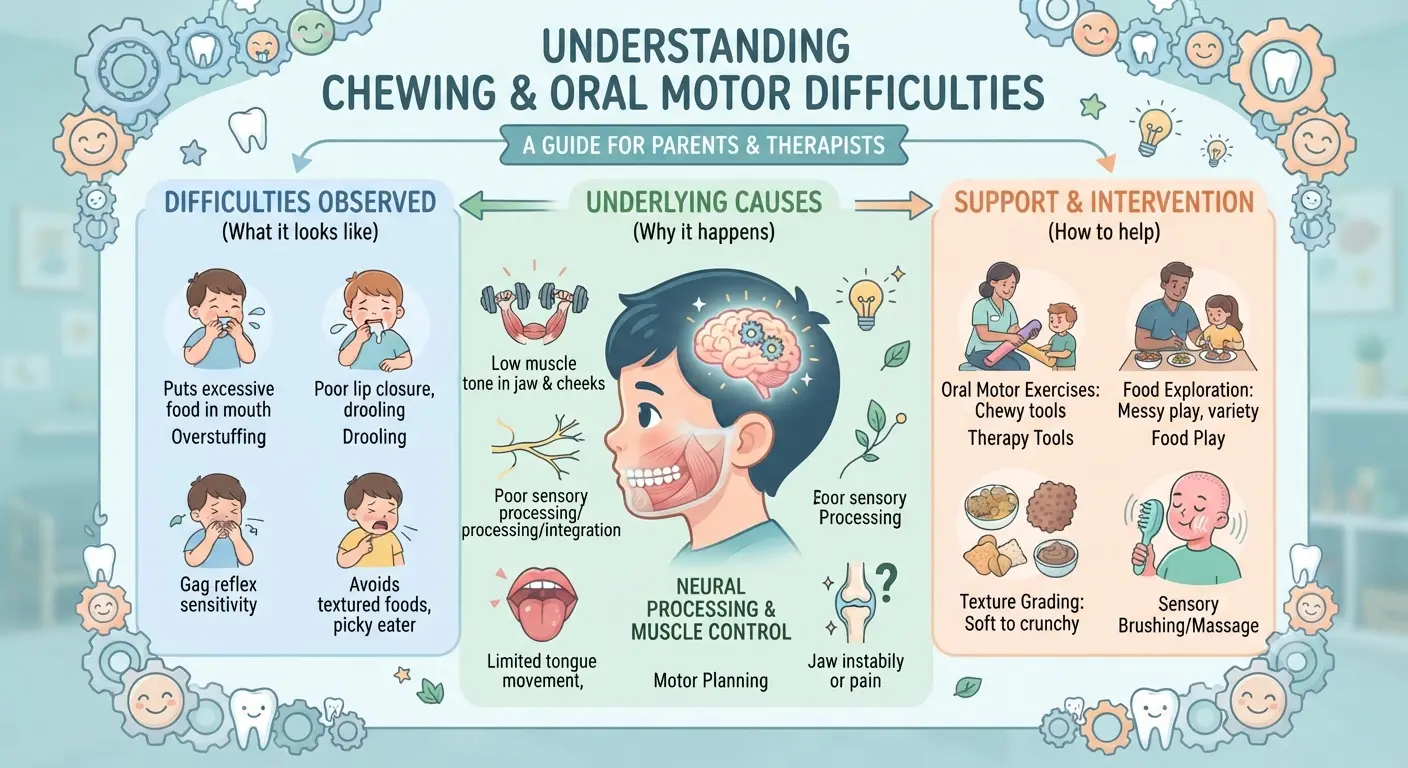
What Are Chewing Oral Motor Difficulties?
Chewing oral motor difficulties are developmental or sensory challenges that impair a child’s ability to coordinate their jaw, tongue, and lips to break down solid food textures safely and efficiently before swallowing.
💡 Clinical Insight: Pocketing food in the cheeks or excessive gagging is often a sign of motor incoordination, not intentional behavioral refusal. Always assess jaw strength and tongue lateralization first.
Understanding Chewing Oral Motor Difficulties in Children
Feeding is one of the most complex motor activities a child performs. It requires rapid coordination between the masseter muscles, tongue lateralization, and swallowing reflexes. When one part of this chain is weak, feeding difficulties arise.
Summary: Symptoms & Therapy Options for Chewing Difficulties
| Difficulty Level | Common Symptoms | Primary Cause | Therapeutic Solution |
|---|---|---|---|
| Mild (Sensory) | Spitting out lumps, pocketing food | Oral sensory hypersensitivity | Textured chew tools & non-food oral play. |
| Moderate (Muscle Weakness) | Open-mouth chewing, jaw fatigue | Weak jaw & cheek muscles | Resistance chew exercises & jaw stability work. |
| Severe (Motor Coordination) | Frequent gagging, choking risk | Lack of tongue lateralization | Full SLP feeding evaluation & structured therapy. |
Clinical Guidelines & Therapeutic Support
Clinical resources from the American Speech-Language-Hearing Association (ASHA) indicate that combining targeted oral motor therapy with gradual texture progression yields the highest rate of success in young children.
To implement a structured home program, explore our actionable list of 50 Oral Motor Exercises for Chewing. To plan safe mealtime transitions, refer to our comprehensive Food Texture Progression Plan.
1. What Are Oral–Motor Skills?
Oral–motor skills involve the movement, strength, and coordination of the muscles used for:
- chewing food
- biting
- moving food in the mouth
- swallowing
- speech production
Key structures involved:
| Oral Structure | Function |
|---|---|
| Jaw | Opening and closing for chewing |
| Tongue | Moving food side to side |
| Lips | Keeping food inside mouth |
| Cheeks | Holding food between teeth |
If these muscles do not work together properly, chewing becomes difficult.
2. Signs of Chewing–Oral Motor Difficulties
Parents and therapists may notice the following signs:
| Sign | Description |
|---|---|
| Food pocketing | Food stays in cheeks |
| Swallowing without chewing | Child gulps food |
| Gagging frequently | Sensitive oral response |
| Drooling | Weak lip control |
| Eating very slowly | Poor chewing efficiency |
| Refusing textured food | Difficulty managing textures |
| Chewing only on front teeth | Lack of molar chewing |
| Food falling out of mouth | Weak lip closure |
These behaviors indicate problems with oral coordination or muscle strength.
3. Causes of Chewing–Oral Motor Difficulties
Several factors can contribute to these difficulties.
1. Low Muscle Tone
Weak muscles in the mouth make chewing tiring.
Example: Children with Down syndrome often have reduced muscle tone.
2. Motor Planning Problems
The brain struggles to coordinate chewing movements.
Example: Children with Autism spectrum disorder may experience oral motor planning challenges.
3. Sensory Processing Issues
The child may be sensitive to textures or temperatures.
Example: Soft foods are accepted, but crunchy foods are rejected.
4. Delayed Feeding Development
Some children do not progress from purees to textured foods on time.
5. Medical Conditions
Certain neurological or structural conditions affect chewing ability.
4. Types of Chewing Patterns
| Type | Description |
|---|---|
| Vertical chewing | Up-and-down jaw movement (early stage) |
| Diagonal chewing | Slight side movement |
| Rotary chewing | Mature circular chewing pattern |
Children with oral motor difficulty may remain stuck in vertical chewing.
5. Assessment of Chewing Skills
Therapists observe:
- jaw stability
- tongue movement
- lip closure
- chewing pattern
- ability to manage different textures
They may also assess swallowing safety.
6. Therapy Approaches
Oral Motor Exercises
These strengthen mouth muscles.
Examples:
- blowing bubbles
- straw drinking
- lip closure exercises
- tongue movement activities
Chewing Practice
Therapists gradually introduce different food textures.
Progression:
- Puree
- Mashed food
- Soft solids
- Crunchy foods
Sensory Desensitization
Children explore food through:
- touching
- smelling
- licking
before chewing.
Jaw Strength Activities
Examples:
- chewing tubes
- crunchy foods
- bite-and-hold exercises
7. Home Activities for Parents
Parents can support therapy with simple exercises.
| Activity | Benefit |
|---|---|
| Blowing bubbles | Strengthens lips |
| Drinking with straw | Improves oral control |
| Eating crunchy snacks | Builds jaw strength |
| Making funny faces | Improves muscle coordination |
| Tongue side movements | Helps food movement |
8. When to Seek Professional Help
Consult a speech-language pathologist if the child:
- chokes frequently during meals
- cannot chew solid foods after age 2-3
- gags often
- refuses most food textures
- takes more than 40 minutes to eat
Early intervention improves feeding development.
9. Long-Term Goals of Therapy
Therapy aims to help the child:
- chew food efficiently
- swallow safely
- eat a variety of textures
- develop independence during meals
These skills also support speech development and oral coordination.
Frequently Asked Questions
What causes chewing oral motor difficulties in young children?
Chewing oral motor difficulties are typically caused by weak jaw muscles, poor tongue lateralization, sensory processing differences, delayed motor milestones, or anatomical factors like tongue-tie.
How can I tell if my child has a chewing problem versus picky eating?
Picky eaters refuse foods based on preference or taste. Children with chewing oral motor difficulties struggle physically to bite, chew, or move food inside their mouth, often pocketing food or gagging.
When should I consult a speech-language pathologist (SLP) for chewing difficulties?
Consult an SLP or pediatric feeding therapist if your child frequently gags or chokes on soft foods, avoids all solid textures past 18 months, or takes over 45 minutes to complete a meal.
[…] breaks with physical oral-motor and motor-planning exercises. Learn more in our detailed guides on Chewing Oral Motor Difficulties: Signs, Causes & Therapy and explore additional sensory-building strategies on Melveno Books […]
[…] oral sensory seeking, combine your daily schedule with targeted exercises outlined in our guide on Chewing Oral Motor Difficulties: Signs, Causes & Therapy. For digital and classroom settings, you can also integrate interactive breaks from our collection […]
[…] oral sensory seeking, combine your daily schedule with targeted exercises outlined in our guide on Chewing Oral Motor Difficulties: Signs, Causes & Therapy. For digital and classroom settings, you can also integrate interactive breaks from our collection […]